
What is an AI agent, and when does a team need one?
An AI agent can choose a next step and use permitted tools to work toward a goal. Compare a chatbot, a fixed workflow and an agent on one delivery enquiry.
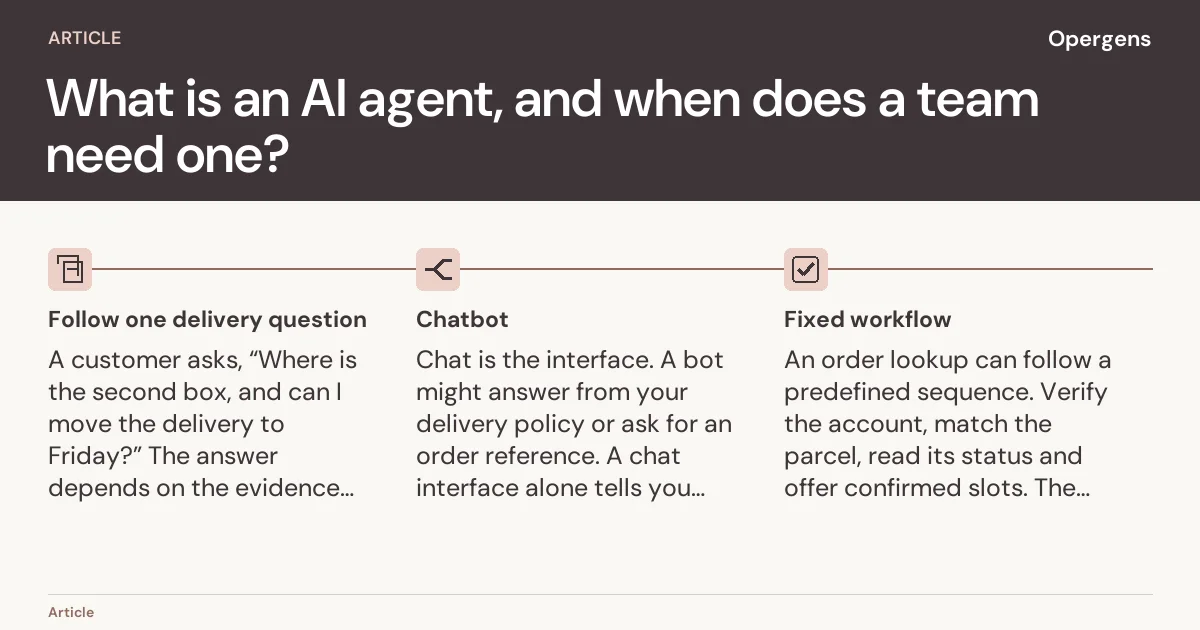
Follow one delivery question
A customer asks, “Where is the second box, and can I move the delivery to Friday?” The answer depends on the evidence available and the authority you give the system.
Chatbot
Chat is the interface. A bot might answer from your delivery policy or ask for an order reference. A chat interface alone tells you little about whether it can see the booking or change anything.
- Follow one delivery question
- A customer asks, “Where is the second box, and can I move the delivery to Friday?” The answer depends on the evidence available and the authority you give the system.
- Chatbot
- Chat is the interface. A bot might answer from your delivery policy or ask for an order reference. A chat interface alone tells you little about whether it can see the booking or change anything.
- Fixed workflow
- An order lookup can follow a predefined sequence. Verify the account, match the parcel, read its status and offer confirmed slots. The next step is set by the rules your team agreed.
Fixed workflow
An order lookup can follow a predefined sequence. Verify the account, match the parcel, read its status and offer confirmed slots. The next step is set by the rules your team agreed.
Tool-using agent
An agent may decide whether to check a scan, ask for a missing reference or look up slots. You define the tools, accessible records, spending or action limits and the point where a person approves a change.
When is a fixed workflow enough?
If every request needs the same fields and the same approval, a form and a rule may handle the whole task. If the useful step is drafting a reply from known sources, try an assistant in your existing software. Consider an agent when routes vary and there is a meaningful choice of next action.
What should stay with a person?
Start by naming the costly action. On this desk it is changing a delivery commitment. Looking up a slot and promising it to a customer require different permissions. Put the confirmation where the booking happens and keep the person who can correct it in the loop.
Four questions for an agent supplier
Which records can it see?
Ask the supplier to repeat the enquiry using two accounts with similar names. Look for the account boundary in the actual sources returned.
What happens when a tool fails?
Disconnect the carrier feed in a test. Watch whether the workflow explains what is missing and routes the request to someone who can finish it.
Who owns a proposed change?
Have a supervisor decline a suggested slot. The audit record should preserve the proposal, the decision and the unchanged booking.
What does a checked answer cost?
Compare subscription, usage, connection maintenance and staff review time against the ordinary desk procedure.
Read further or bring the question to class
Anthropic’s engineering guide describes the distinction between predefined workflows and systems that choose their next action. The workshop applies that distinction to a process your team already operates.
Read the engineering guide See the agent selection workshop