
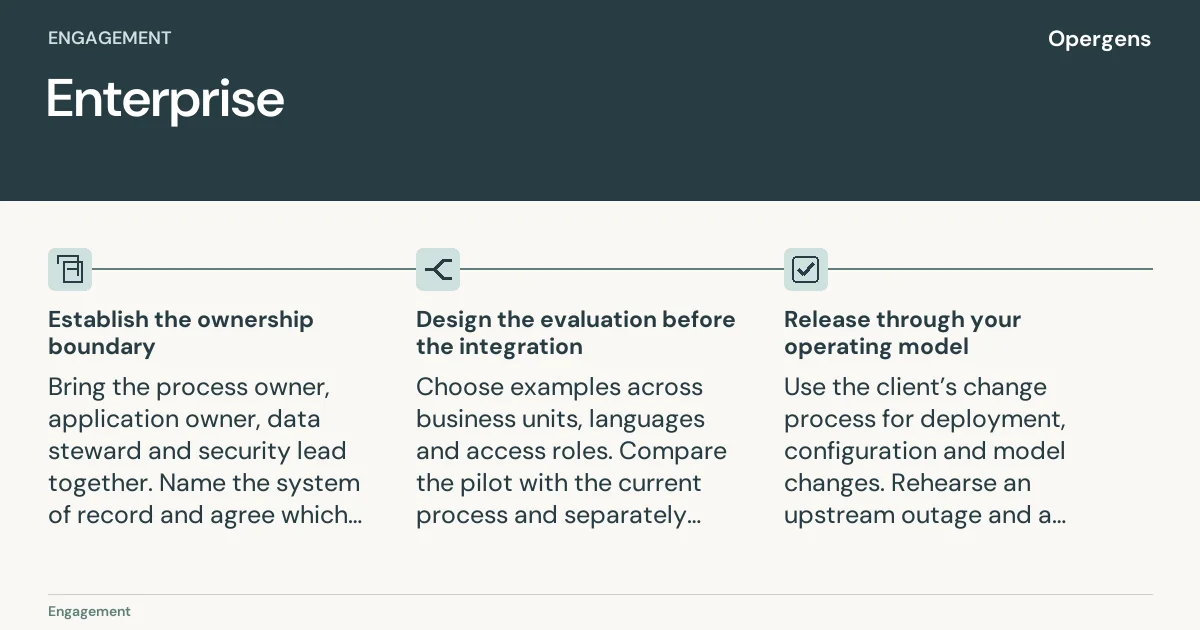
Establish the ownership boundary
Bring the process owner, application owner, data steward and security lead together. Name the system of record and agree which identity can read it. Document the additional approval required for any action that writes back.
- Establish the ownership boundary
- Bring the process owner, application owner, data steward and security lead together. Name the system of record and agree which identity can read it. Document the additional approval required for any action that writes back.
- Design the evaluation before the integration
- Choose examples across business units, languages and access roles. Compare the pilot with the current process and separately measure material errors, latency, review effort and ongoing cost. A single average can conceal a failure on a sensitive segment.
- Release through your operating model
- Use the client’s change process for deployment, configuration and model changes. Rehearse an upstream outage and a partial write. Demonstrate that a replay preserves record consistency and leaves a human-readable audit trail.
Design the evaluation before the integration
Choose examples across business units, languages and access roles. Compare the pilot with the current process and separately measure material errors, latency, review effort and ongoing cost. A single average can conceal a failure on a sensitive segment.
Release through your operating model
Use the client’s change process for deployment, configuration and model changes. Rehearse an upstream outage and a partial write. Demonstrate that a replay preserves record consistency and leaves a human-readable audit trail.
Expand deliberately
Introduce a limited cohort, train its users and establish a channel for corrections. Expand only when the process owner accepts the evidence and an operator can support the system without depending on one individual.