
Client identity
The CRM account differs from the entity in the engagement letter
What Opergens would build
Resolve the proposed matter, signed client name, parent and billing entity with cited source records. An authorized partner handles conflicts and confirms setup before ERP billing begins.
Which entity has actually engaged the practice?
- CRM opportunity: Alder Holdings Ltd
- Signed engagement: Alder Trading Ltd
Refer the subsidiary for the required checks and verify the billing setup. Keep the matter unopened pending clearance.
Billing guideline
A fee draft breaches outside counsel guidelines
What Opergens would build
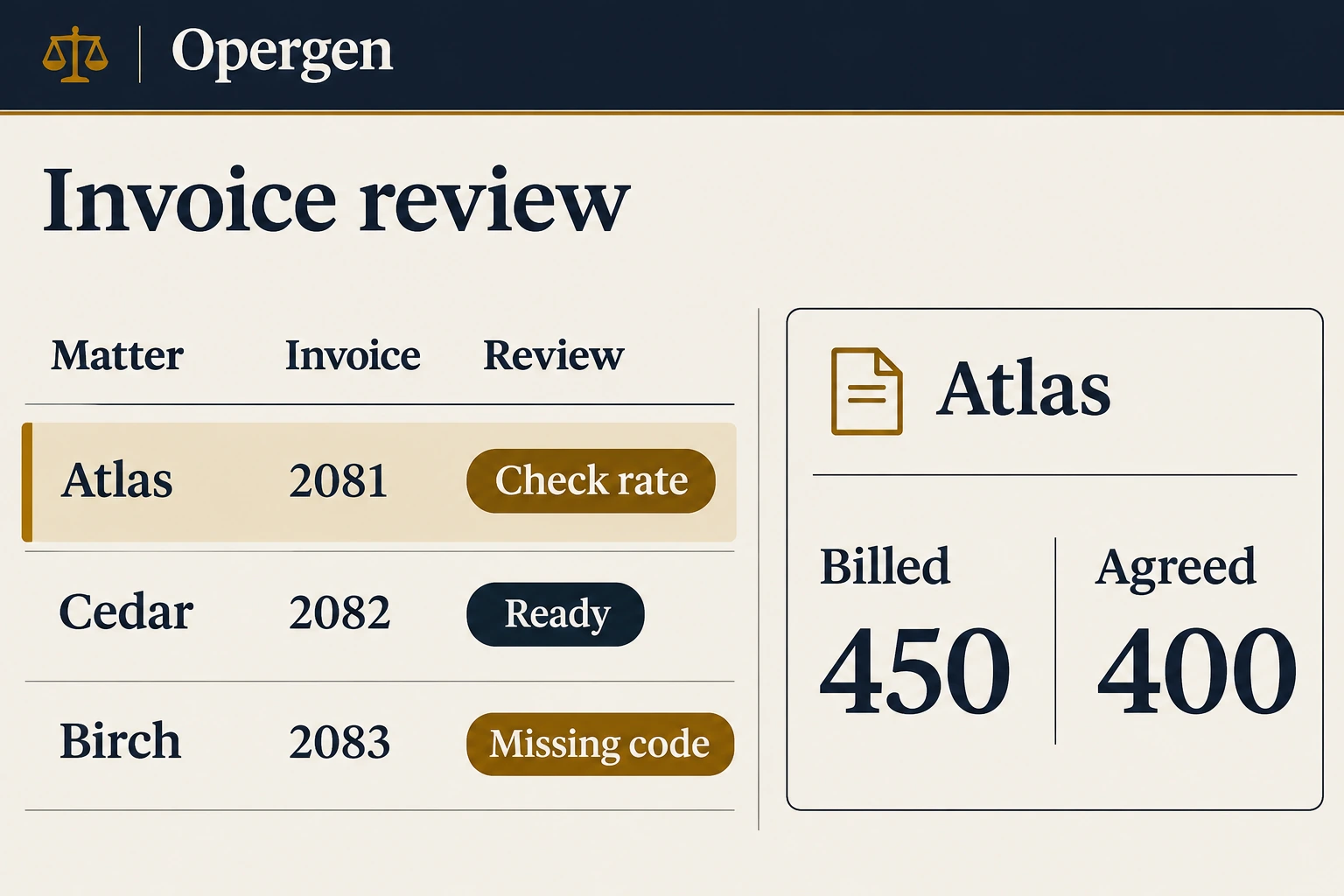
Compare time entries and rate dates with the client’s approved billing rules. Finance flags questionable codes while the billing partner decides edits and write-offs.
Is prior approval on file for this time entry?
- Time entry T-91: 2.0 hours internal conference
- Client guideline rev 4: prior approval required
Request the approval reference and isolate T-91 from the release batch. Keep its treatment open for partner review.
Notice amendment
A later amendment changes a notice obligation
What Opergens would build
Trace term, address and effective date across executed documents. Counsel approves the controlling interpretation and docketing staff verify the proposed reminder.
Does Amendment 2 govern the upcoming renewal?
- Signed agreement §8: notice 60 days before renewal
- Amendment 2 §3: notice 90 days before renewal
Check effective date and scope against the signed amendment. Leave the calendar change provisional until counsel approves.
Planning the implementation
Which legal entity is the client, which party pays and which matters must remain screened from the reviewer?
- Where work gets stuck
- A CRM relationship, signed engagement and billing account may describe three distinct entities.
- Implementation choice
- Configure permitted CRM-to-matter matching first. Add document extraction for signed scope and rates while partners retain conflicts clearance.
- What your team receives
- A matter-opening pack with verified entities, restricted records, agreed fee basis and partner approval.
Opening the right client and billing the right entity
A group company introduces a new subsidiary for a matter. The CRM lists the parent as the relationship owner, an engagement draft names the subsidiary and accounts receivable has a separate billing entity. A single intake view makes all three distinctions explicit and identifies the supporting documents. Restricted information stays within its authorized matter workspace. The designated partner confirms client identity, conflicts clearance and engagement terms. Finance receives only the approved setup fields and the applicable rate schedule.
Matter intake / opening review
Open| Review field | Source value |
|---|---|
| Practice | Commercial advisory |
| Engagement | Signed draft conflict |
| Billing entity | Confirm |
- Crm opportunity details
- Signed engagement letters
- Approved practice management billing records
The law firm intake partner verifies the file and authorizes the next administrative step.
Test clients using trading names, separate billing entities, multiple matters under one group and restricted matters. Verify that the pack reaches only permitted reviewers and that time and billing setup follows the signed engagement terms.
Reconcile client intake, matter opening and billing setup
Prepare an intake pack showing the CRM account, proposed client and billing entity and any unresolved ownership information. An authorized partner confirms conflicts clearance and scope before opening the matter.
The working record
The working records include CRM opportunity details, signed engagement letters and approved practice management billing records. The law firm intake partner verifies the file and authorizes the next administrative step. A useful first artifact is a reviewed example with the source beside each finding. It gives the business owner a concrete way to mark information that is missing, out of date or assigned to the wrong record.
What can the reviewer rely on?
Agree which signed document, approved policy or ledger entry controls when two sources disagree. A reviewer should be able to open that source from the proposed finding, see the relevant date and leave a reason for an override. Compare a built-in search or document feature with a custom extraction workflow on the same set of conflicting records.
Systems and integration
A typical scope spans cRM, matter management, document management and finance ERP. Start with a restricted reporting view or an approved export. Keep the source record identifier, version and observation time in the review interface. Agree how late changes are surfaced and which source is authoritative when identifiers disagree.
One possible platform setup
Salesforce or Dynamics 365 for client relationships and NetSuite where approved client and billing records are synchronized.
What to test in a pilot
Test clients using trading names, separate billing entities, multiple matters under one group and restricted matters. Verify that the pack reaches only permitted reviewers and that time and billing setup follows the signed engagement terms. The primary measure is reviewed files with the correct record, source version and documented handling of unresolved items. Evaluate the current process and the pilot against the same files, and record the cases on which experienced reviewers disagree.
Production and handover
Keep the accepted record and the reviewer’s explanation in the operating register. The law firm intake partner owns reopened items. If a source is amended after review, preserve the earlier version, flag the affected file and show the difference before it returns to the queue.
Other workflows we can develop
Fee arrangement review
Compare signed scope, rate schedules and ERP billing setup. The responsible partner and finance reviewer resolve differences before draft invoices go out.
Knowledge reuse
Retrieve permitted precedents by practice area, date and matter restrictions. A supervising lawyer checks suitability and confidentiality before reuse.
Published industry cases
Trace diligence findings back to the deal room
Harvey describes how Clayton Utz lawyers use its tools to search large document collections and support transaction diligence. The firm emphasizes checking the underlying source for a finding.
