
Observe the task
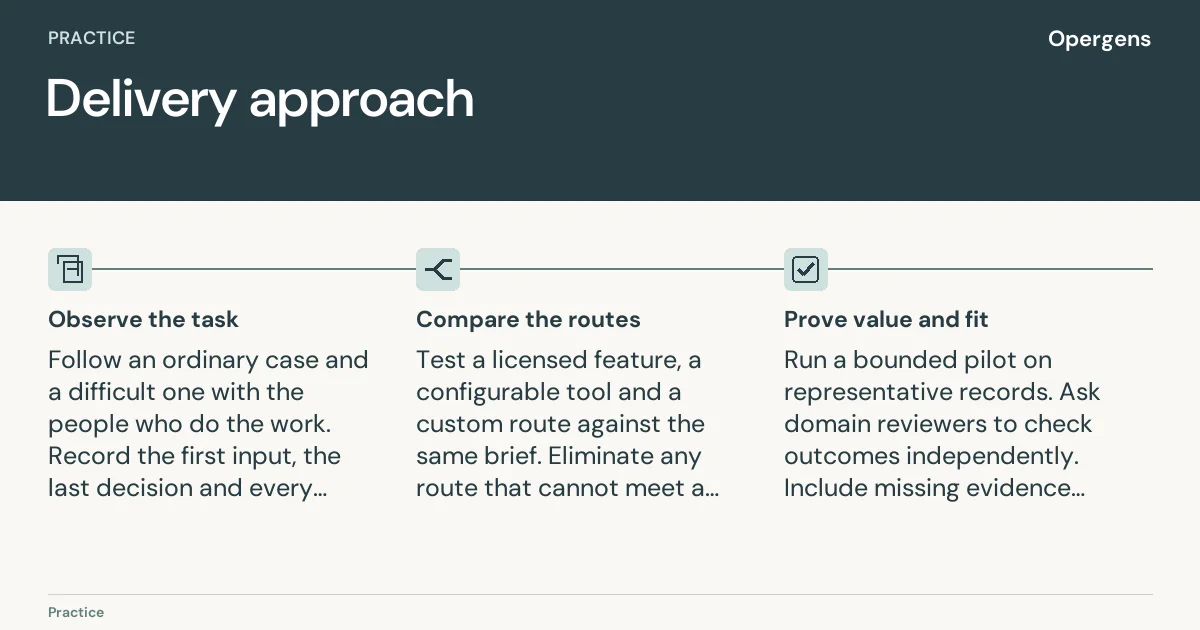
Follow an ordinary case and a difficult one with the people who do the work. Record the first input, the last decision and every manual handoff between them. Capture time spent on correction as well as time spent on preparation. This gives the pilot an honest comparison.
- Observe the task
- Follow an ordinary case and a difficult one with the people who do the work. Record the first input, the last decision and every manual handoff between them. Capture time spent on correction as well as time spent on preparation. This gives the pilot an honest comparison.
- Compare the routes
- Test a licensed feature, a configurable tool and a custom route against the same brief. Eliminate any route that cannot meet a mandatory access or deployment constraint. Write down assumptions about usage, support effort and exit costs, then ask the sponsor which ones deserve testing.
- Prove value and fit
- Run a bounded pilot on representative records. Ask domain reviewers to check outcomes independently. Include missing evidence, inconsistent source data, denied access and requests that should return to a person. A decision memo records whether to stop, revise the scope or invest in production.
Compare the routes
Test a licensed feature, a configurable tool and a custom route against the same brief. Eliminate any route that cannot meet a mandatory access or deployment constraint. Write down assumptions about usage, support effort and exit costs, then ask the sponsor which ones deserve testing.
Prove value and fit
Run a bounded pilot on representative records. Ask domain reviewers to check outcomes independently. Include missing evidence, inconsistent source data, denied access and requests that should return to a person. A decision memo records whether to stop, revise the scope or invest in production.
Build the operating system around the model
A reliable application needs identity, data contracts, retries, approvals, evaluation, monitoring and release control. Choose the hosting environment with the client and rehearse recovery with the operator. Document who owns prompts, connectors, keys, data and model changes.
Train, hand over and improve
Train users on realistic work and train administrators on the failure paths. Compare actual review effort with the pilot baseline. Use corrections, incidents and feedback to decide whether to adjust instructions, improve the underlying data, change a tool or retire the workflow.