
Count work after the output appears
A purchased tool may generate the right summary but leave someone copying it into another application. A custom tool can remove that handoff while requiring ongoing model evaluation and support. Compare the routes at the point where the business task is actually finished.
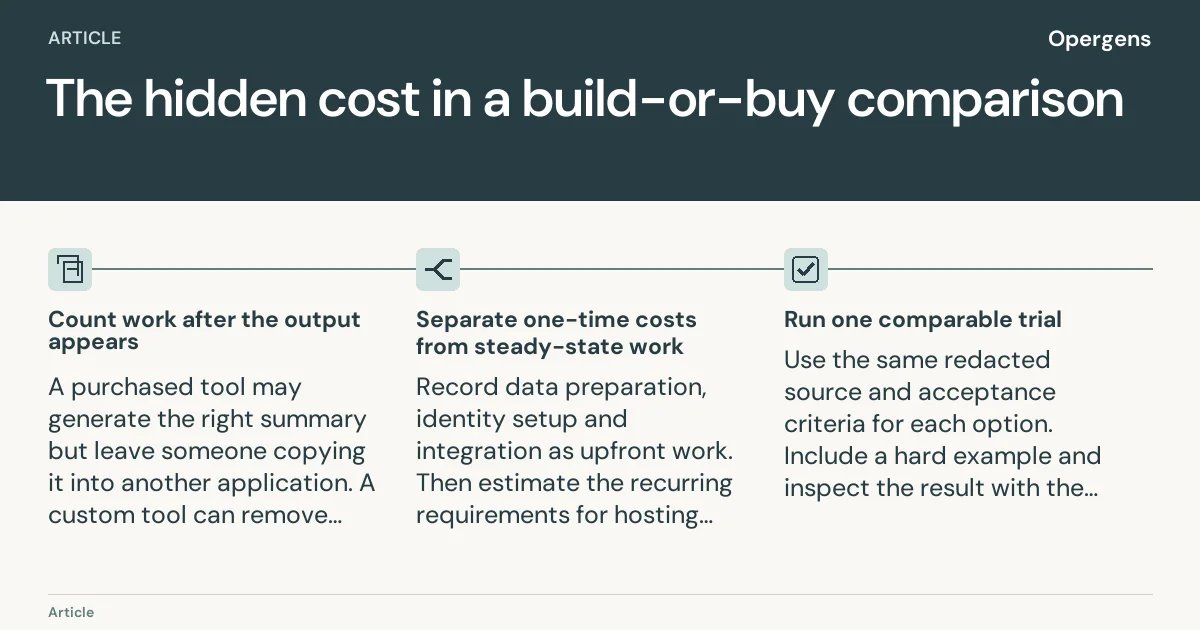
- Count work after the output appears
- A purchased tool may generate the right summary but leave someone copying it into another application. A custom tool can remove that handoff while requiring ongoing model evaluation and support. Compare the routes at the point where the business task is actually finished.
- Separate one-time costs from steady-state work
- Record data preparation, identity setup and integration as upfront work. Then estimate the recurring requirements for hosting, licenses, exception review, monitoring and changes to the source system. Identify which assumptions depend on usage volume.
- Run one comparable trial
- Use the same redacted source and acceptance criteria for each option. Include a hard example and inspect the result with the person who would approve it. Ask an administrator to demonstrate access removal and data export. Record any question the supplier or internal team could not answer.
Separate one-time costs from steady-state work
Record data preparation, identity setup and integration as upfront work. Then estimate the recurring requirements for hosting, licenses, exception review, monitoring and changes to the source system. Identify which assumptions depend on usage volume.
Run one comparable trial
Use the same redacted source and acceptance criteria for each option. Include a hard example and inspect the result with the person who would approve it. Ask an administrator to demonstrate access removal and data export. Record any question the supplier or internal team could not answer.
Agree what would change the decision
A change in volume, a stricter hosting boundary or an improved licensed feature may change the economics. A useful decision record names that trigger and an owner for the next review. This gives the company a way to reconsider without restarting discovery from scratch.
Work the arithmetic on one queue
Suppose a queue receives 1,200 eligible cases in a month. If a proposed tool removes three minutes of preparation per case, that releases 60 hours. If the same cases require two extra minutes of review, 40 hours return to the workload. The remaining 20 hours still have to cover monitoring, licensing and support. These are planning assumptions a buyer can replace with observed values.
Check the number that can reverse the choice
Review a handful of peak-period cases with the team. A tool that needs little checking for ordinary orders can consume a supervisor’s time for exceptions. Ask finance to show how the recommendation changes when the share of difficult cases doubles. Keep the calculation beside the decision so the business can revisit it after rollout.