
Reconstruct the balance
Imagine a supplier invoices 1,000, then issues a credit of 200 before payment. An invoice extractor may read both files perfectly. The harder question is whether the payable balance is 800 and whether that credit has already been allocated elsewhere. Ask for the invoice identifier, credit reference, allocation history and currency together.
- Reconstruct the balance
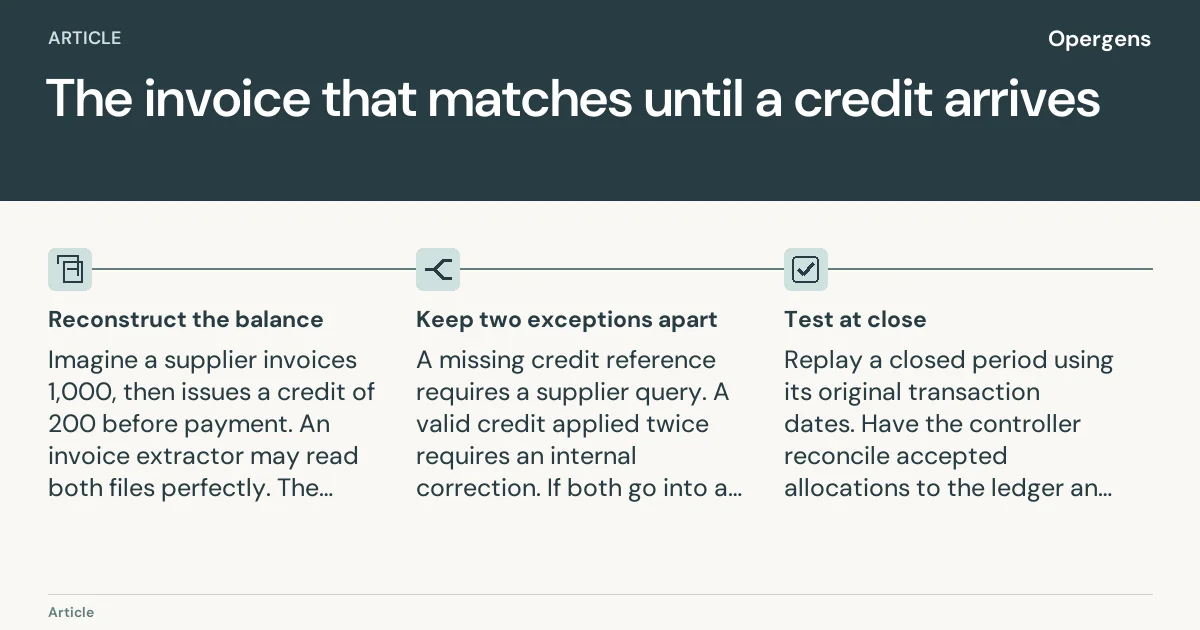
- Imagine a supplier invoices 1,000, then issues a credit of 200 before payment. An invoice extractor may read both files perfectly. The harder question is whether the payable balance is 800 and whether that credit has already been allocated elsewhere. Ask for the invoice identifier, credit reference, allocation history and currency together.
- Keep two exceptions apart
- A missing credit reference requires a supplier query. A valid credit applied twice requires an internal correction. If both go into a generic “low confidence” queue, the accounts team still has to rediscover the reason for the hold. Give each exception a destination and show the reviewer where the difference came from.
- Test at close
- Replay a closed period using its original transaction dates. Have the controller reconcile accepted allocations to the ledger and trace each held line. Use the unresolved balance and the time to explain it when deciding whether the next supplier belongs in scope.
Keep two exceptions apart
A missing credit reference requires a supplier query. A valid credit applied twice requires an internal correction. If both go into a generic “low confidence” queue, the accounts team still has to rediscover the reason for the hold. Give each exception a destination and show the reviewer where the difference came from.
Test at close
Replay a closed period using its original transaction dates. Have the controller reconcile accepted allocations to the ledger and trace each held line. Use the unresolved balance and the time to explain it when deciding whether the next supplier belongs in scope.