
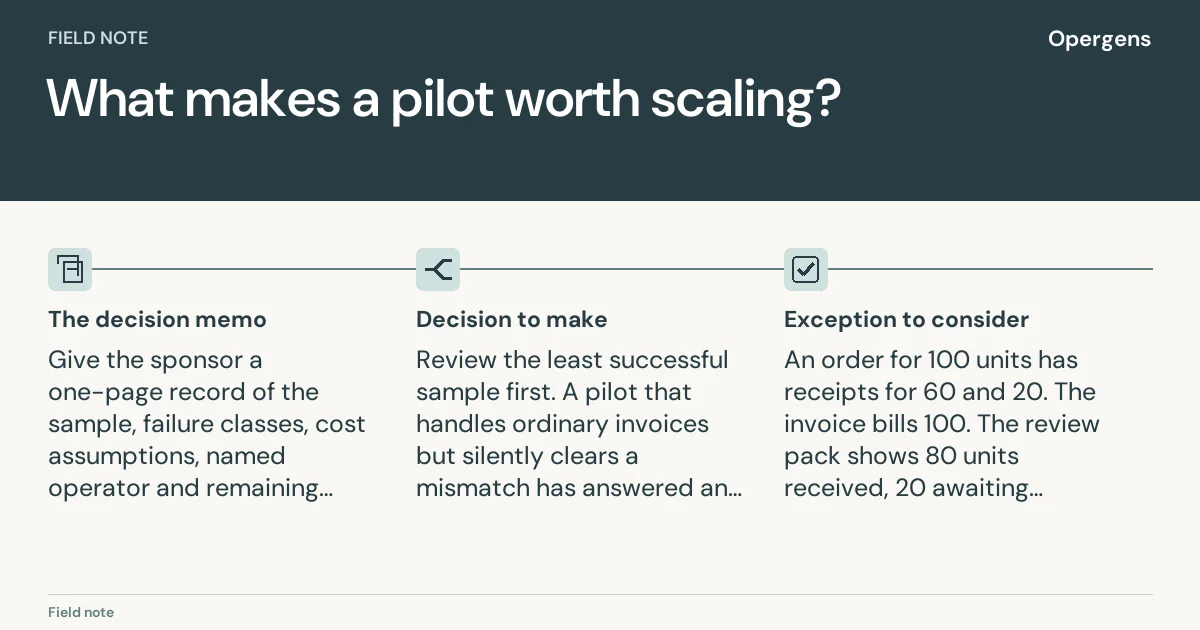
The decision memo
Give the sponsor a one-page record of the sample, failure classes, cost assumptions, named operator and remaining questions. Separate a fix that can be tested tomorrow from a dependency that changes the economics of the project.
Decision to make
Review the least successful sample first. A pilot that handles ordinary invoices but silently clears a mismatch has answered an important question about where the approval boundary belongs.
Exception to consider
An order for 100 units has receipts for 60 and 20. The invoice bills 100. The review pack shows 80 units received, 20 awaiting evidence and both receipt references. Tax treatment and any approval to pay remain with the assigned finance owner.
Use this guide
Read the method in sequence
Pick the comparison
Measure the current workflow first. For invoice reconciliation, count exceptions, review time and incorrect matches. Preserve difficult examples in the test set.
Review the misses
Ask the people who own the work to score representative outputs. Distinguish a cosmetic error from a wrong record update. Define the cases that must always return to a person.
Price the operation
Estimate hosting, licenses, review effort and support at expected volume. A pilot can save preparation time while adding enough review work to cancel the gain.
Write the decision
The sponsor records whether to scale, revise or stop. A decision to scale names an operating owner, an initial rollout group and a rollback condition.
Inspect a completed decision record
Three-way match worksheet
- Order line: PO-41/2
- Ordered: 100 units
- Receipts: R-11 for 60 and R-15 for 20
- Billed: 100 units
- Variance: 20 units
- Payment decision: held for the AP reviewer
Inspect the review notes
Review every line using the units, currency and tax basis agreed by finance. Ask a receiving colleague to resolve the physical delivery discrepancy and reserve release of funds for the usual approver. Keep the amounts that reconciled visible so the next reviewer does not repeat that work.
Set up the trial
Collect comparable examples
Match company code, supplier identifier, invoice number, order line, receipt and currency. Preserve each document reference separately. Identical invoice numbers can occur with different suppliers. Quantities may arrive in cases on the invoice and individual units in the receipt.
Observe the handoff
Normalize units using an approved conversion table. Work line by line and group partial deliveries. Show which amount reconciles, the remaining disputed quantity and the receiving contact. The AP reviewer determines whether to seek another receipt, open a dispute or route the invoice through existing payment controls.
Review the evidence
Sample credit notes, split deliveries, taxes, freight and repeated uploads. Score the cost of an incorrect clearance separately from a needless referral. Finance should be able to reconstruct each proposed match even after the underlying order changes.
Adapt the scope to your organization
Start with one team
Start with one frequent document family and a handful of high-value fields. Keep correction beside the source scan.
Extend across teams
Segment by supplier, language and layout. Review rare amendments and duplicate identifiers and define how corrections can enter a future training set.
- The decision memo
- Give the sponsor a one-page record of the sample, failure classes, cost assumptions, named operator and remaining questions. Separate a fix that can be tested tomorrow from a dependency that changes the economics of the project.
- Decision to make
- Review the least successful sample first. A pilot that handles ordinary invoices but silently clears a mismatch has answered an important question about where the approval boundary belongs.
- Exception to consider
- An order for 100 units has receipts for 60 and 20. The invoice bills 100. The review pack shows 80 units received, 20 awaiting evidence and both receipt references. Tax treatment and any approval to pay remain with the assigned finance owner.