
The environment inventory
Draw the source system, document store, model endpoint, identity provider, output destination, diagnostic tools and backups. For each, identify who controls the account, which data crosses the boundary and how an operator obtains and relinquishes access.
Decision to make
Test the diagram with an actual request. A privately hosted intake application may still send extracted text to an external endpoint or retain diagnostic samples in another region. The real route determines which hosting option fits.
Exception to consider
A resident supplies a two-page confirmation letter instead of the usual certificate. The checklist recognizes a possible alternative and sends both pages to the officer. A missing certificate checkbox alone cannot establish that the resident is ineligible.
Use this guide
Read the method in sequence
Follow a single record
Trace the input, model request, retrieved text, output and logs. Include transcripts, caches and backups. A private application can still send data to a hosted model.
Choose who owns each layer
For a client-hosted build, agree who owns the cloud account, identity provider, keys, model endpoint and monitoring. For a managed service, document the export and handover path.
Test the boundary
Use a representative access matrix to test permitted and denied requests. Verify the retention settings and inspect where diagnostic logs go.
Rehearse handover
Have the designated operator restore a backup and roll back a release using the runbook. Capture missing access or instructions before expanding usage.
Inspect a completed decision record
Application evidence sheet
- Submission: resident file R-07
- Evidence supplied: two-page confirmation letter
- Usual certificate: absent
- Status: alternative evidence needs officer review
- Resident action: await confirmation before asking for another document
Inspect the review notes
Check the language used in requests for additional information with the service team. The recipient should understand which document or fact is missing, how to supply it and whom to contact if the standard route is inaccessible. Retain the original submission date through correction.
Set up the trial
Collect comparable examples
List required evidence by published service type and submission date. Accept common document variants, record whether scanned pages are legible and preserve the original filing. Make room for applicants who submit in a second language or use an assisted channel.
Observe the handoff
Extract administrative fields, identify missing pages and link each item back to the submitted file. The officer can correct an extraction, request a clearer copy or mark an allowed alternative. The service retains its existing authority and appeal route for any determination about eligibility.
Review the evidence
Compare file completeness and repeat requests by channel and document type. Review a sample of handwriting and translated submissions. Have an officer reproduce the review using the original evidence and verify that the resident can correct an administrative mistake.
Adapt the scope to your organization
Start with one team
Start with one high-volume form and a short checklist designed with frontline staff and service users.
Extend across teams
Evaluate service access across channels, language needs and case types. Test assisted submissions, records retention and correction after an officer handover.
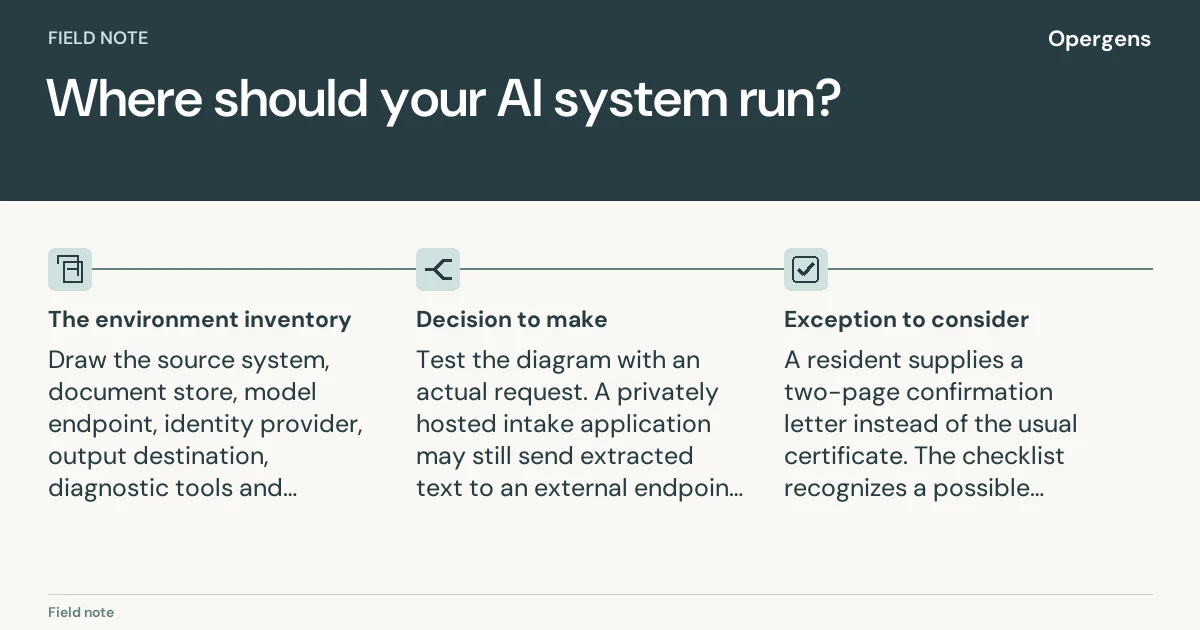
- The environment inventory
- Draw the source system, document store, model endpoint, identity provider, output destination, diagnostic tools and backups. For each, identify who controls the account, which data crosses the boundary and how an operator obtains and relinquishes access.
- Decision to make
- Test the diagram with an actual request. A privately hosted intake application may still send extracted text to an external endpoint or retain diagnostic samples in another region. The real route determines which hosting option fits.
- Exception to consider
- A resident supplies a two-page confirmation letter instead of the usual certificate. The checklist recognizes a possible alternative and sends both pages to the officer. A missing certificate checkbox alone cannot establish that the resident is ineligible.