
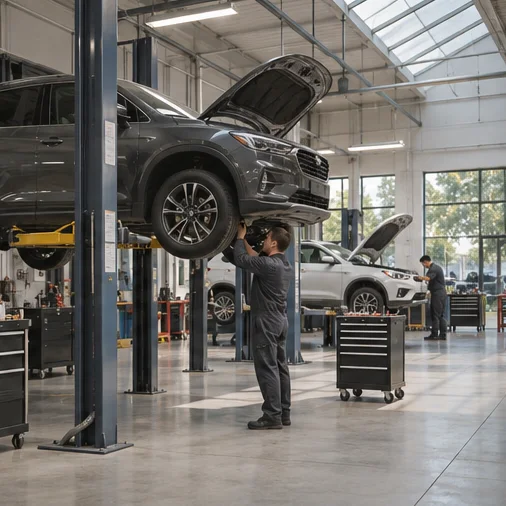
Dealer symptoms
One field issue has several dealer descriptions
What Opergens would build
Group permitted warranty narratives by symptom, configuration and repair record. A warranty specialist inspects source cases before opening a common investigation.
Is there enough evidence for one investigation?
- Dealer claim D51 describes screen flicker on trim A, display revision 2
- D74 describes flashing on trim B, display revision 4
Retain both cases and request configuration-matched examples before treating the symptoms as a shared issue.
Bulletin scope
A bulletin reaches the wrong model year
What Opergens would build
Match applicability statements to vehicle configuration and production period. Dealer support sees excluded variants and checks the bulletin before reuse.
Does this vehicle fall within B14?
- Bulletin B14 lists model year 2023 with option H2
- Service record V62 lists model year 2024 with H2
Withhold B14 from the proposed response and request the applicable 2024 guidance.
Repeat repair
A repeat repair looks like a separate fault
What Opergens would build
Reconstruct the vehicle’s repair history by part and date. An analyst can distinguish repeat visits from distinct events before comparing warranty trends.
Does the second visit need repeat-repair review?
- Repair R20 records a display replacement for vehicle V73 on 3 June
- R28 records the same symptom on V73 on 16 June
Link both visits for inspection and leave the fault diagnosis and claim disposition open.
Planning the implementation
Does the recurring repair involve the same vehicle configuration, part revision and earlier intervention?
- Where work gets stuck
- Free-text dealer narratives look similar across models even when the relevant fault and bulletin differ.
- Implementation choice
- Use configuration filters before clustering repair descriptions. Add a specialist review queue for repeated symptoms with conflicting repairs.
- What your team receives
- A warranty cluster pack with representative claims, repair chronology, applicability and excluded variants.
Group warranty issues by failure mode
A dealer submits a repeat claim after a component replacement. Group comparable claims by part revision, fault description and model year. Surface the earlier repair so the analyst can distinguish a return visit from a new event.
Warranty review desk
Open- Warranty claims
- Parts records
- Workshop descriptions
A warranty specialist reviews clusters and escalates recurring issues.
Include superseded parts, repeated dealer submissions and similar symptoms across model variants. Score mistaken groupings at the vehicle and part levels, and check that individual claims remain traceable.
The working record
The working records include warranty claims, parts records and workshop descriptions. A warranty specialist reviews clusters and escalates recurring issues. A useful first artifact is a reviewed example with the source beside each finding. It gives the business owner a concrete way to mark information that is missing, out of date or assigned to the wrong record.
What is authoritative at shift change?
Trace an asset, batch or service location through the operational systems with a planner. Record where the identifier changes and how corrections reach the incoming shift. Compare the native reporting view with a connected review pack. A pilot earns its place when staff can resolve exceptions more reliably under the time constraints of a real handover.
Systems and integration
A typical scope spans dealer warranty, parts master and product quality records. Where the business record lives in SAP, agree the company, plant or organizational unit and the document key before extracting any fields. Begin with an authorized read path. Route a proposed correction through the existing business transaction and keep the approval reference beside it.
One possible platform setup
If dealer cases arrive in Dynamics 365, match them to warranty and part-revision exports. A restricted Snowflake view can support cross-dealer analysis without duplicating customer records.
What to test in a pilot
Include superseded parts, repeated dealer submissions and similar symptoms across model variants. Score mistaken groupings at the vehicle and part levels, and check that individual claims remain traceable. The primary measure is share of repeat cases grouped correctly. Evaluate the current process and the pilot against the same files, and record the cases on which experienced reviewers disagree.
Production and handover
Give the warranty owner a review queue with links to dealer records and product changes. Engineers can investigate accepted clusters through the established process for field issues.
Other workflows we can develop
Dealer guidance retrieval
Retrieve the current dealer bulletin and applicability conditions for a vehicle configuration. A warranty specialist checks the model and effective date before issuing guidance.
Parts supersession checks
Compare claim part numbers with supersession records and repair dates. Prepare a mismatch queue for the parts lead to verify against the master catalog.
Published industry cases
Surface a quality issue while the item is still on the line
BMW describes AIQX analyzing image and sensor data from production lines for quality monitoring. Its production overview places this beside existing factory processes and testing technologies.
