
Catalogue edition
A course change creates different rules for active cohorts
What Opergens would build
Map approved curriculum revisions to entry year, degree pathway and enrollment status. The registrar verifies which students require updated guidance.
Which requirement applies to a 2025 entrant?
- 2025 entry catalogue: elective E2 accepted
- 2026 course revision: E2 withdrawn
Link the student record to its entry catalogue and seek a decision on transition rules. Keep the degree check open.
Transfer credit
Faculty need evidence for a transfer-credit decision
What Opergens would build
Retrieve course descriptions, credit values and applicable articulation agreements with source dates. Faculty reviews academic equivalence, and the registrar records the authorized decision.
What evidence does faculty need to assess equivalence?
- External course: 3 credits, 2024 syllabus
- Proposed equivalent: 4 credits, 2025 outcomes
Request the teaching hours and assessed outcomes. Keep award of transfer credit pending faculty judgment.
Grant reconciliation
A department cannot reconcile a restricted grant expenditure
What Opergens would build
Connect the grant budget, approved amendment and ledger record by project and period. Research finance reviews ambiguous charges before reporting them to the funder.
Was the cost incurred inside the award period?
- Grant G-28: travel approved through 30 June
- Ledger journal: conference travel posted 8 July
Obtain the travel and invoice dates and compare them with the award terms. Keep the allocation pending review.
Planning the implementation
What academic evidence does faculty need to decide an equivalence without reopening several catalogs?
- Where work gets stuck
- A source transcript, a department’s prior decision and an articulation agreement may refer to different curriculum years.
- Implementation choice
- Use the student information system for final decisions. Add cited retrieval across approved curricula and agreements to prepare faculty review.
- What your team receives
- A credit review file with module outcomes, credits, effective dates, prior references and the authorized decision.
Two catalog editions, one course code
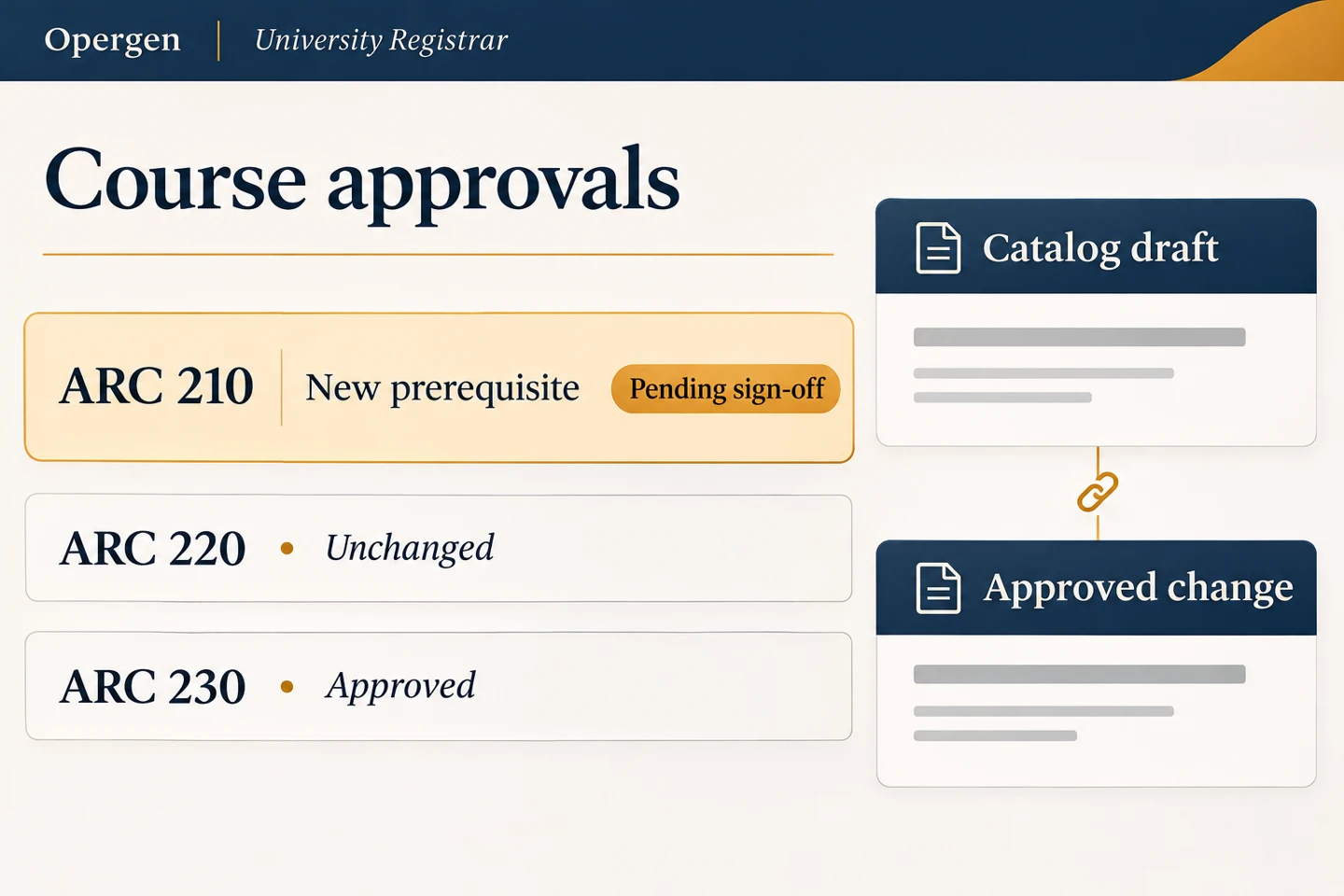
A student enrolling under last year’s catalog asks whether the new ARC 210 prerequisite applies. A search by course code alone returns both editions. A registrar-facing view pairs the change notice with its effective term and shows the edition governing the student’s programme. Staff can then explain the applicable rule or refer an exception to the appropriate academic office.
Prepare a transfer-credit evidence file for faculty
Retrieve the applicable catalog and recorded articulation agreement, map source modules to possible equivalents and highlight gaps in credits or learning outcomes. Faculty determines academic equivalence and the registrar records the authorized outcome.
Our practice has worked with education organizations. We scope each engagement around the institution’s own systems and the staff authorized to make academic or administrative decisions.
The working record
The working records include submitted transcripts, approved module descriptions and dated articulation agreements. The registrar and designated faculty reviewer verifies the file and authorizes the next administrative step. A useful first artifact is a reviewed example with the source beside each finding. It gives the business owner a concrete way to mark information that is missing, out of date or assigned to the wrong record.
Who can inspect the underlying record?
Start with the permitted purpose, the roles allowed to read each source and the records that can be shown in a review pack. Compare the current case or document system with an assisted workflow using a small approved sample. Include language, accessibility and incomplete evidence in the review wherever they affect the people receiving the service.
Systems and integration
A typical scope spans student information, curriculum management and controlled academic records. Start with a restricted reporting view or an approved export. Keep the source record identifier, version and observation time in the review interface. Agree how late changes are surfaced and which source is authoritative when identifiers disagree.
One possible platform setup
SharePoint for approved curriculum records and Microsoft Entra ID for faculty and registrar access.
What to test in a pilot
Test merged departments, changed credit values and an expired agreement. Separate evidence retrieval from academic judgment and check that restricted records are visible only to permitted reviewers. The primary measure is reviewed files with the correct record, source version and documented handling of unresolved items. Evaluate the current process and the pilot against the same files, and record the cases on which experienced reviewers disagree.
Production and handover
Keep the accepted record and the reviewer’s explanation in the operating register. The registrar and designated faculty reviewer owns reopened items. If a source is amended after review, preserve the earlier version, flag the affected file and show the difference before it returns to the queue.
Other workflows we can develop
Programme amendment impact
Map a revised prerequisite to active cohorts and registration notices for academic administration.
Research administration
Match funding milestones, authorized expenditure records and deliverables for a grants officer to verify.
Published industry cases
Answer enrollment questions during the admissions handover
Georgia State’s 2017 account describes Pounce, its AI-enabled messaging assistant for newly admitted students. It sent reminders and answered questions during the transition from admission to enrollment. This is a historical implementation report.
Implementation playbooks
Another decision this team handles
Registrar desk / transfer credit
Open- Programme
- Business studies
- Module
- Statistics
- Equivalence
- Faculty review
- Submitted transcripts
- Approved module descriptions
- Dated articulation agreements
The registrar and designated faculty reviewer verifies the file and authorizes the next administrative step.
Test merged departments, changed credit values and an expired agreement. Separate evidence retrieval from academic judgment and check that restricted records are visible only to permitted reviewers.
