
Resolution handover
- Issue: duplicate charge
- Identity: verified by support
- Order: amendment confirmed
- Responsible queue: billing
- Follow-up: investigate disputed amount
- Case closure: pending confirmation
Inspect the review notes
Give the receiving specialist sufficient context and remove material outside its access rights. A transfer can be fast and still fail if it leaves the customer explaining the issue from the beginning.
How the work moves
Follow the operating sequence
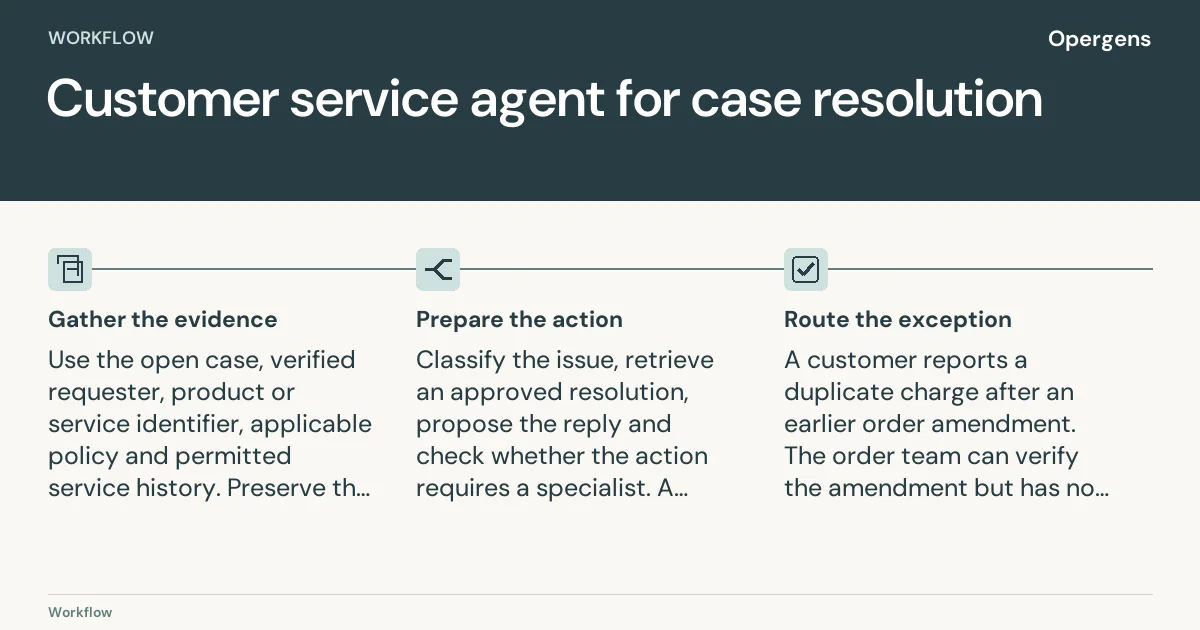
Gather the evidence
Use the open case, verified requester, product or service identifier, applicable policy and permitted service history. Preserve the original message and the service-level deadline. Start with the queue in which staff already resolve cases and the actions those staff may authorize.
Prepare the action
Classify the issue, retrieve an approved resolution, propose the reply and check whether the action requires a specialist. A human reviews and sends the response. If a ticket is transferred, carry forward the identity check, evidence and unresolved request. Keep the case open until the promised action is verified.
Route the exception
A customer reports a duplicate charge after an earlier order amendment. The order team can verify the amendment but has no authority to issue a refund. The agent prepares a billing handover with the matched order and disputed amount, retaining the ticket and its current deadline.
Compare a complete record with an exception
Source and permissions
Use the open case, verified requester, product or service identifier, applicable policy and permitted service history. Preserve the original message and the service-level deadline. Start with the queue in which staff already resolve cases and the actions those staff may authorize.
Exception to rehearse
A customer reports a duplicate charge after an earlier order amendment. The order team can verify the amendment but has no authority to issue a refund. The agent prepares a billing handover with the matched order and disputed amount, retaining the ticket and its current deadline.
Test the workflow on real operating conditions
Measure confirmed resolution and repeated contact alongside drafting time. Test a customer who disputes the suggested explanation, an account visible to the sender but restricted for the receiving queue and two channels reporting the same issue.
Measure what happens beyond the chat window. A quick answer that produces a second call is expensive for the buyer. Route uncertain or private questions with a summary that identifies completed identity checks, unresolved actions and the policy version consulted.
Agree who takes ownership
What Opergens delivers
A conversation design, approved knowledge sources, a reviewed handover summary and a test set covering ambiguous requests and account-specific actions.
What the operator verifies
A service agent can take over with the context needed to resolve the case. The customer can ask for a person and review the actions proposed on their behalf.
- Gather the evidence
- Use the open case, verified requester, product or service identifier, applicable policy and permitted service history. Preserve the original message and the service-level deadline. Start with the queue in which staff already resolve cases and the actions those staff may authorize.
- Prepare the action
- Classify the issue, retrieve an approved resolution, propose the reply and check whether the action requires a specialist. A human reviews and sends the response. If a ticket is transferred, carry forward the identity check, evidence and unresolved request. Keep the case open until the promised action is verified.
- Route the exception
- A customer reports a duplicate charge after an earlier order amendment. The order team can verify the amendment but has no authority to issue a refund. The agent prepares a billing handover with the matched order and disputed amount, retaining the ticket and its current deadline.