
Replenishment decision sheet
- Item: dried fruit carton
- Observed: two promotional days followed by a stockout
- Planning horizon: supplier lead time plus order cycle
- Candidate order: pending stock verification
- Owner: category planner
Inspect the review notes
Agree in advance which costs enter the comparison. Ordering an extra carton has different consequences for a perishable item and a spare part. Ask the planner to document overrides with a reason that can later be distinguished from errors in the recorded stock position.
How the work moves
Follow the operating sequence
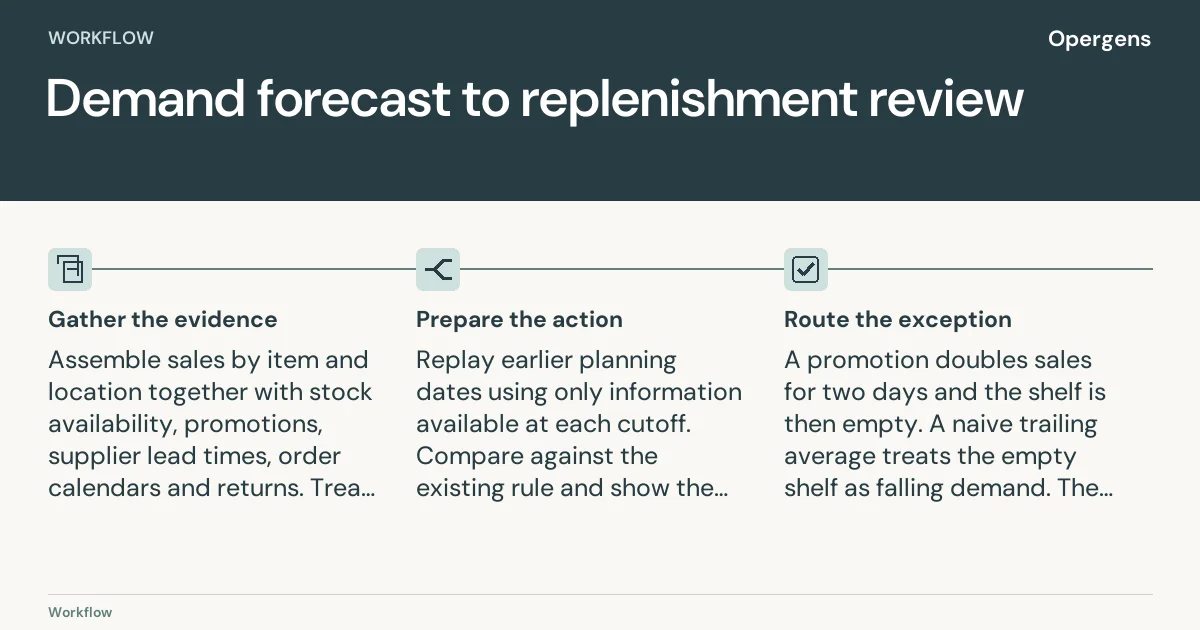
Gather the evidence
Assemble sales by item and location together with stock availability, promotions, supplier lead times, order calendars and returns. Treat a zero-sales day during a stockout differently from an ordinary day with no sales. A forecast used to place an order must reflect what the planner knew at that point.
Prepare the action
Replay earlier planning dates using only information available at each cutoff. Compare against the existing rule and show the likely range over the lead time. Translate demand into order packs, apply minimum order quantities and surface exceptions for review at the usual weekly meeting.
Route the exception
A promotion doubles sales for two days and the shelf is then empty. A naive trailing average treats the empty shelf as falling demand. The example worksheet marks the censored dates and invites the planner to adjust the promotion assumption before committing stock.
Compare a complete record with an exception
Source and permissions
Assemble sales by item and location together with stock availability, promotions, supplier lead times, order calendars and returns. Treat a zero-sales day during a stockout differently from an ordinary day with no sales. A forecast used to place an order must reflect what the planner knew at that point.
Exception to rehearse
A promotion doubles sales for two days and the shelf is then empty. A naive trailing average treats the empty shelf as falling demand. The example worksheet marks the censored dates and invites the planner to adjust the promotion assumption before committing stock.
Test the workflow on real operating conditions
Compare availability, excess stock and order changes on held-out weeks. Report bias separately for slow movers and promoted items. Log overrides with a reason so the next review can distinguish local knowledge from a recurring data defect.
Maintain separate scores for predictive accuracy and decision quality. An order meeting a supplier minimum can be rational even when it exceeds the forecast. Run rolling historical forecasts and compare service levels alongside carrying costs and the effort introduced by exceptions.
Agree who takes ownership
What Opergens delivers
A benchmark forecast, uncertainty ranges, feasible planning options and a replay showing how each option would have performed against the current planning rule.
What the operator verifies
A planner can inspect a recommendation, vary a binding constraint and explain why an apparently better average forecast could produce a worse order.
- Gather the evidence
- Assemble sales by item and location together with stock availability, promotions, supplier lead times, order calendars and returns. Treat a zero-sales day during a stockout differently from an ordinary day with no sales. A forecast used to place an order must reflect what the planner knew at that point.
- Prepare the action
- Replay earlier planning dates using only information available at each cutoff. Compare against the existing rule and show the likely range over the lead time. Translate demand into order packs, apply minimum order quantities and surface exceptions for review at the usual weekly meeting.
- Route the exception
- A promotion doubles sales for two days and the shelf is then empty. A naive trailing average treats the empty shelf as falling demand. The example worksheet marks the censored dates and invites the planner to adjust the promotion assumption before committing stock.