
Serving cost comparison
- Comparison unit: approved invoice page
- Workload: morning intake plus idle hours
- Candidate configurations: existing endpoint, compact model and staged processing
- Quality gate: verified critical fields
- Operational gate: review queue cleared before payment cutoff
Inspect the review notes
Calculate cost from successful completions in the period. Record the idle capacity, queueing, retries, transfer and storage costs that remain outside an isolated model call. A deployment that looks inexpensive at constant peak use may cost more under the actual arrival pattern.
How the work moves
Follow the operating sequence
Gather the evidence
Build a replay from representative page counts, scan quality, language, request lengths, arrival times and permitted processing locations. Keep cold periods as well as the morning peak. Identify the deadline and the business consequence of letting documents queue.
Prepare the action
Benchmark the current model, a smaller alternative and staged processing on identical document batches. Separate setup time from steady operation and include human review required to correct errors. The service owner can choose a different route for a short clean document and a difficult scan.
Route the exception
In the morning intake batch, a smaller model returns shorter invoices on time yet sends the rare handwritten pages to an overloaded reviewer. The infrastructure bill falls while the approval queue misses its deadline. The trial report includes both effects before changing the routing rule.
Compare a complete record with an exception
Source and permissions
Build a replay from representative page counts, scan quality, language, request lengths, arrival times and permitted processing locations. Keep cold periods as well as the morning peak. Identify the deadline and the business consequence of letting documents queue.
Exception to rehearse
In the morning intake batch, a smaller model returns shorter invoices on time yet sends the rare handwritten pages to an overloaded reviewer. The infrastructure bill falls while the approval queue misses its deadline. The trial report includes both effects before changing the routing rule.
Test the workflow on real operating conditions
Replay realistic bursts and idle intervals. Record accepted pages per hour, the slowest routine requests, failed retries, reviewer effort and cost for the complete billing period. Recheck results after a model, hardware, workload or provider-price change.
Batching can raise throughput while increasing the wait for an early request. Evaluate candidates at the service deadline and retain the tail of the latency distribution. Include the staff who review referrals and the capacity that remains provisioned overnight.
Agree who takes ownership
What Opergens delivers
A replayable workload, configuration comparison, unit-economics worksheet and operating thresholds for capacity, queue age and cost alerts.
What the operator verifies
The selected configuration clears the agreed workload at the required quality under peak and routine conditions. The service owner can explain the consequences of growth, lower demand or a price change.
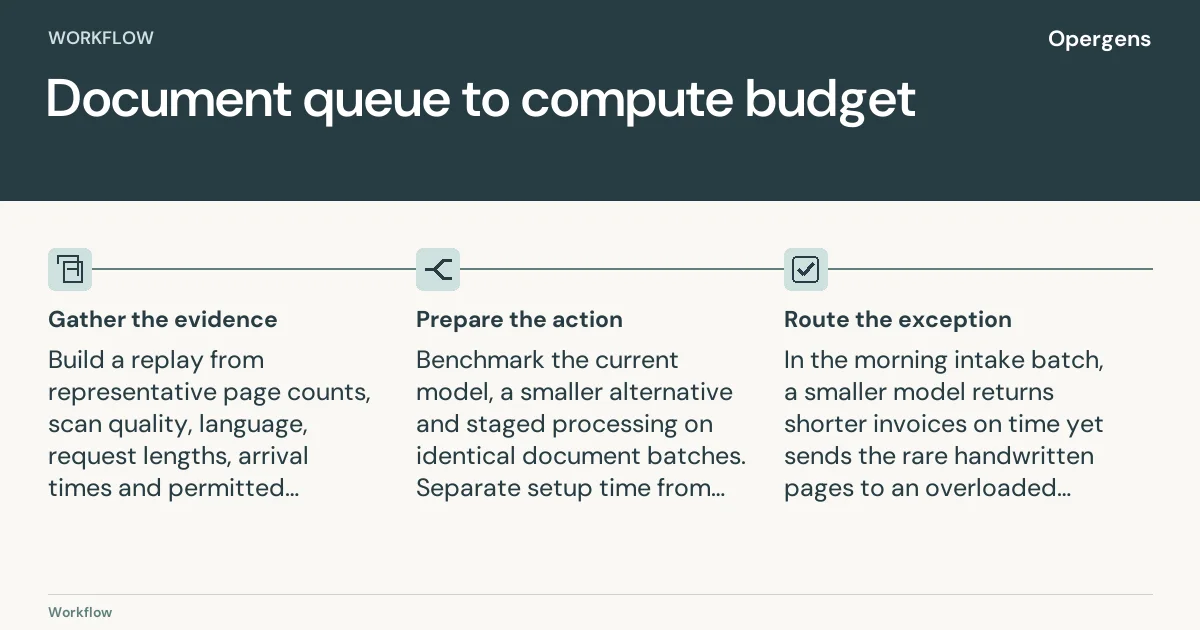
- Gather the evidence
- Build a replay from representative page counts, scan quality, language, request lengths, arrival times and permitted processing locations. Keep cold periods as well as the morning peak. Identify the deadline and the business consequence of letting documents queue.
- Prepare the action
- Benchmark the current model, a smaller alternative and staged processing on identical document batches. Separate setup time from steady operation and include human review required to correct errors. The service owner can choose a different route for a short clean document and a difficult scan.
- Route the exception
- In the morning intake batch, a smaller model returns shorter invoices on time yet sends the rare handwritten pages to an overloaded reviewer. The infrastructure bill falls while the approval queue misses its deadline. The trial report includes both effects before changing the routing rule.