
Conflicts review queue
- Matter type: commercial enquiry
- Matching field: shared trading name
- Possible parties: two registered entities
- Access: intake reviewer
- Matter opening: pending counsel decision
Inspect the review notes
Only the responsible reviewer decides whether a match is consequential. Record the identity issue and its disposition without exposing the underlying confidential matter in a general-purpose CRM or email.
How the work moves
Follow the operating sequence
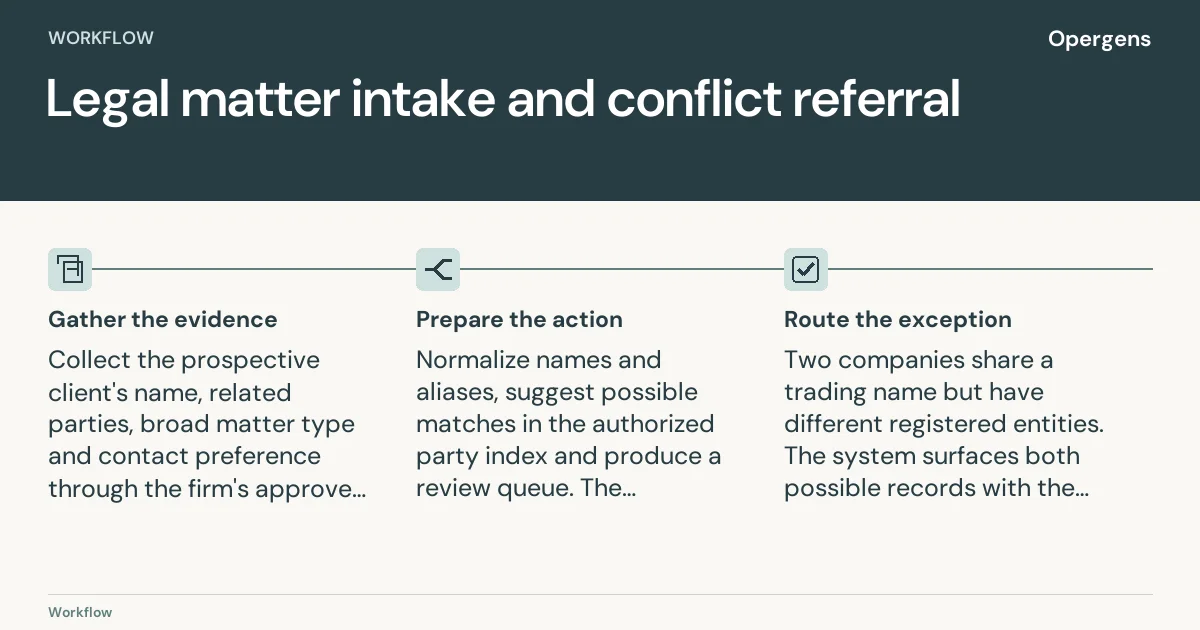
Gather the evidence
Collect the prospective client's name, related parties, broad matter type and contact preference through the firm's approved intake channel. Agree with the intake partner what details may be requested before a conflict check. Restrict access to the existing intake team and preserve the source submission.
Prepare the action
Normalize names and aliases, suggest possible matches in the authorized party index and produce a review queue. The designated conflicts reviewer assesses the matches and decides the next step. Engagement, legal advice and the decision to accept the matter remain with authorized counsel.
Route the exception
Two companies share a trading name but have different registered entities. The system surfaces both possible records with the matched field. It withholds matter opening and routes the case to the conflicts reviewer for identity checks. The prospective client receives the firm's approved acknowledgement.
Compare a complete record with an exception
Source and permissions
Collect the prospective client's name, related parties, broad matter type and contact preference through the firm's approved intake channel. Agree with the intake partner what details may be requested before a conflict check. Restrict access to the existing intake team and preserve the source submission.
Exception to rehearse
Two companies share a trading name but have different registered entities. The system surfaces both possible records with the matched field. It withholds matter opening and routes the case to the conflicts reviewer for identity checks. The prospective client receives the firm's approved acknowledgement.
Test the workflow on real operating conditions
Use fictional records to test aliases, missing parties, false-positive names and restricted matters. Confirm a reviewer outside the permitted group cannot see sensitive details. Measure correct referrals and unresolved intake time before widening the scope.
Design backwards from a partially completed run. List the durable event that records progress and the check that prevents a repeated side effect. Leave a place for the operating team to resume from the last verified state when a dependency recovers.
Agree who takes ownership
What Opergens delivers
A workflow that prepares, routes or reconciles work with visible queues and approval points.
What the operator verifies
A process owner can pause the workflow, inspect exceptions and recover from a partial run.
- Gather the evidence
- Collect the prospective client's name, related parties, broad matter type and contact preference through the firm's approved intake channel. Agree with the intake partner what details may be requested before a conflict check. Restrict access to the existing intake team and preserve the source submission.
- Prepare the action
- Normalize names and aliases, suggest possible matches in the authorized party index and produce a review queue. The designated conflicts reviewer assesses the matches and decides the next step. Engagement, legal advice and the decision to accept the matter remain with authorized counsel.
- Route the exception
- Two companies share a trading name but have different registered entities. The system surfaces both possible records with the matched field. It withholds matter opening and routes the case to the conflicts reviewer for identity checks. The prospective client receives the firm's approved acknowledgement.