
Inference request trace
- Request: Q-184
- Source access: regional staff
- Index: v12
- Model route: private primary
- Secondary endpoint: outside approved region
- Response: queued pending eligible service
Inspect the review notes
Record whether the user received a deferred response and which dependency can clear the work. A returning endpoint still needs a healthy control request before releasing the rest of the queue.
How the work moves
Follow the operating sequence
Gather the evidence
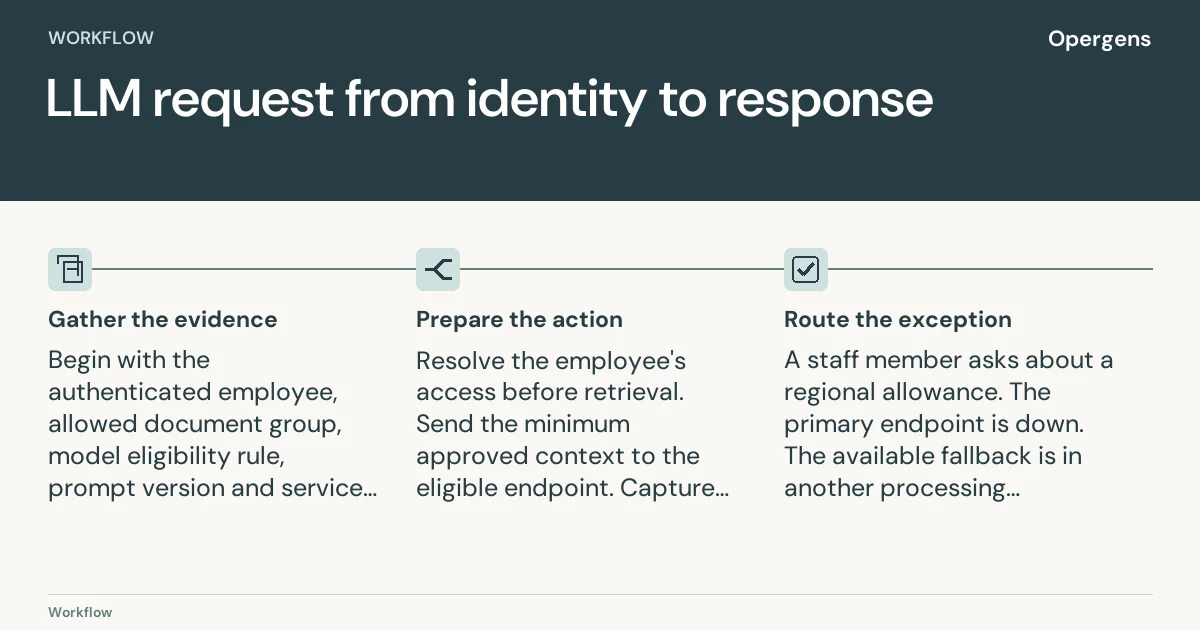
Begin with the authenticated employee, allowed document group, model eligibility rule, prompt version and service budget. Establish which components retain input, retrieved passages, outputs and diagnostic traces. A private application can still send a request to an external inference or embedding service.
Prepare the action
Resolve the employee's access before retrieval. Send the minimum approved context to the eligible endpoint. Capture an opaque request identifier, timings and release versions. When the endpoint fails, route only to a permitted alternative or preserve the task for later review.
Route the exception
A staff member asks about a regional allowance. The primary endpoint is down. The available fallback is in another processing boundary. The gateway holds the request and leaves the prohibited route unused, even though the backup model can answer the question.
Compare a complete record with an exception
Source and permissions
Begin with the authenticated employee, allowed document group, model eligibility rule, prompt version and service budget. Establish which components retain input, retrieved passages, outputs and diagnostic traces. A private application can still send a request to an external inference or embedding service.
Exception to rehearse
A staff member asks about a regional allowance. The primary endpoint is down. The available fallback is in another processing boundary. The gateway holds the request and leaves the prohibited route unused, even though the backup model can answer the question.
Test the workflow on real operating conditions
Test one permitted query, one forbidden passage, a stale index, a long request at peak load and an unavailable endpoint. Inspect both output and logs. The operator must be able to explain the response, queue status and cost without retrieving sensitive text from general telemetry.
A managed gateway can provide a quicker route to stable model access with an approved provider. Private serving adds control over models and data movement while introducing accelerator sizing, upgrades and capacity recovery.
Agree who takes ownership
What Opergens delivers
A reviewed architecture, model gateway configuration, retrieval boundary, release checks, cost view and operating runbook tested against the client's deployment constraints.
What the operator verifies
A restricted identity can access only its approved content. The operator can explain a request, reproduce the release, hold a prohibited fallback and recover an approved endpoint.
- Gather the evidence
- Begin with the authenticated employee, allowed document group, model eligibility rule, prompt version and service budget. Establish which components retain input, retrieved passages, outputs and diagnostic traces. A private application can still send a request to an external inference or embedding service.
- Prepare the action
- Resolve the employee's access before retrieval. Send the minimum approved context to the eligible endpoint. Capture an opaque request identifier, timings and release versions. When the endpoint fails, route only to a permitted alternative or preserve the task for later review.
- Route the exception
- A staff member asks about a regional allowance. The primary endpoint is down. The available fallback is in another processing boundary. The gateway holds the request and leaves the prohibited route unused, even though the backup model can answer the question.