
Decision and action register
- Source: Tuesday project review
- Action: request revised pricing
- Owner: Mira
- Dependency: procurement releases supplier quote
- Due date: open
- Approval to share: meeting organizer
- Readers: project workspace members
Inspect the review notes
Treat assignment, commitment and deadline as three separate judgments. A speaker can describe work without accepting it. A calendar date can describe a review meeting without becoming a delivery deadline. Keep the underlying passage available until the organizer finishes checking the register.
How the work moves
Follow the operating sequence
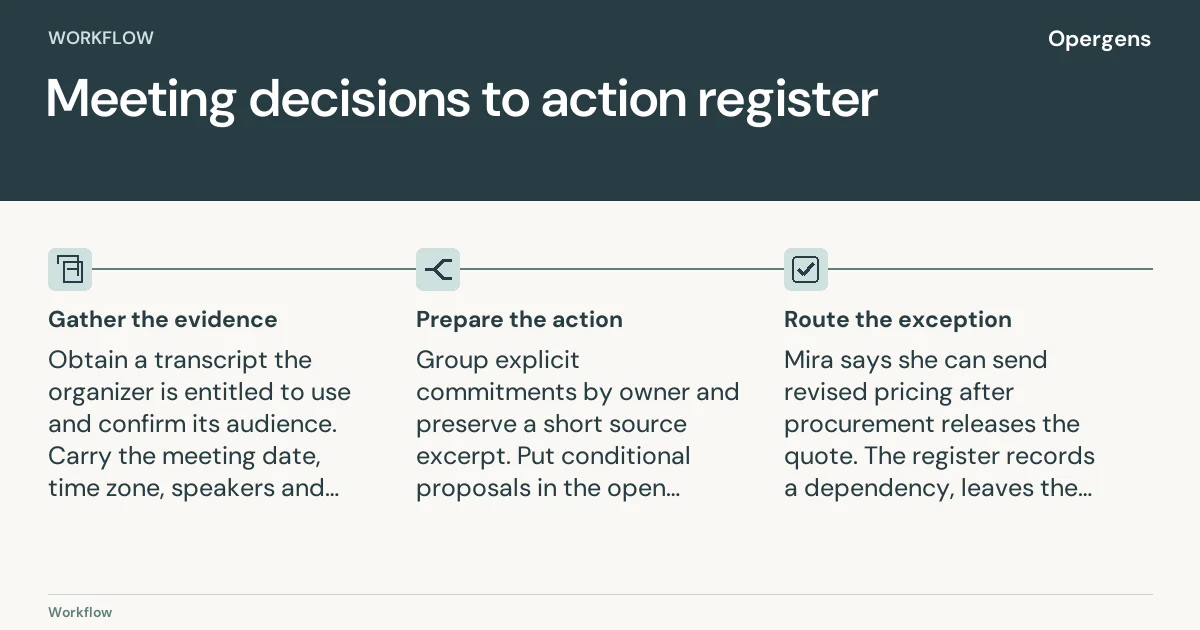
Gather the evidence
Obtain a transcript the organizer is entitled to use and confirm its audience. Carry the meeting date, time zone, speakers and recording consent into the draft. References such as “next Thursday” need an anchor. A follow-up promise may depend on someone outside the meeting.
Prepare the action
Group explicit commitments by owner and preserve a short source excerpt. Put conditional proposals in the open questions column. The organizer reviews identities and dates before publishing to the agreed workspace. Send confirmed owners a copy in the channel where the team already tracks delivery.
Route the exception
Mira says she can send revised pricing after procurement releases the quote. The register records a dependency, leaves the due date open and assigns Mira the follow-up. A second speaker volunteering to review pricing does not become the quote owner.
Compare a complete record with an exception
Source and permissions
Obtain a transcript the organizer is entitled to use and confirm its audience. Carry the meeting date, time zone, speakers and recording consent into the draft. References such as “next Thursday” need an anchor. A follow-up promise may depend on someone outside the meeting.
Exception to rehearse
Mira says she can send revised pricing after procurement releases the quote. The register records a dependency, leaves the due date open and assigns Mira the follow-up. A second speaker volunteering to review pricing does not become the quote owner.
Test the workflow on real operating conditions
Compare the register with notes taken independently by two attendees. Record disagreements about ownership separately from missed actions. Test an external attendee with restricted access and a meeting whose transcript was deleted before processing.
Pick the question that could change the investment decision. For a meeting follow-up tool, that might be whether staff can correct ownership faster than preparing notes by hand. Time the entire review, including the occasions when it is easier to start again.
Agree who takes ownership
What Opergens delivers
A working pilot, a scored evaluation set and a decision memo with unresolved risks and an estimate for production.
What the operator verifies
Business owners can repeat the test and decide whether to proceed, change scope or stop.
- Gather the evidence
- Obtain a transcript the organizer is entitled to use and confirm its audience. Carry the meeting date, time zone, speakers and recording consent into the draft. References such as “next Thursday” need an anchor. A follow-up promise may depend on someone outside the meeting.
- Prepare the action
- Group explicit commitments by owner and preserve a short source excerpt. Put conditional proposals in the open questions column. The organizer reviews identities and dates before publishing to the agreed workspace. Send confirmed owners a copy in the channel where the team already tracks delivery.
- Route the exception
- Mira says she can send revised pricing after procurement releases the quote. The register records a dependency, leaves the due date open and assigns Mira the follow-up. A second speaker volunteering to review pricing does not become the quote owner.