
Order completion projection
- Target: 12,000
- Good units at noon: 8,400
- Remaining: 3,600
- Rate: 1,000 per productive hour
- Planned downtime: 30 minutes
- Projected finish: 16:06
Inspect the review notes
Three hours and thirty-six minutes of productive time plus a thirty-minute stop moves the expected finish six minutes past the dispatch cutoff. Ask the supervisor to verify the stop and uncertainty before changing the plan.
How the work moves
Follow the operating sequence
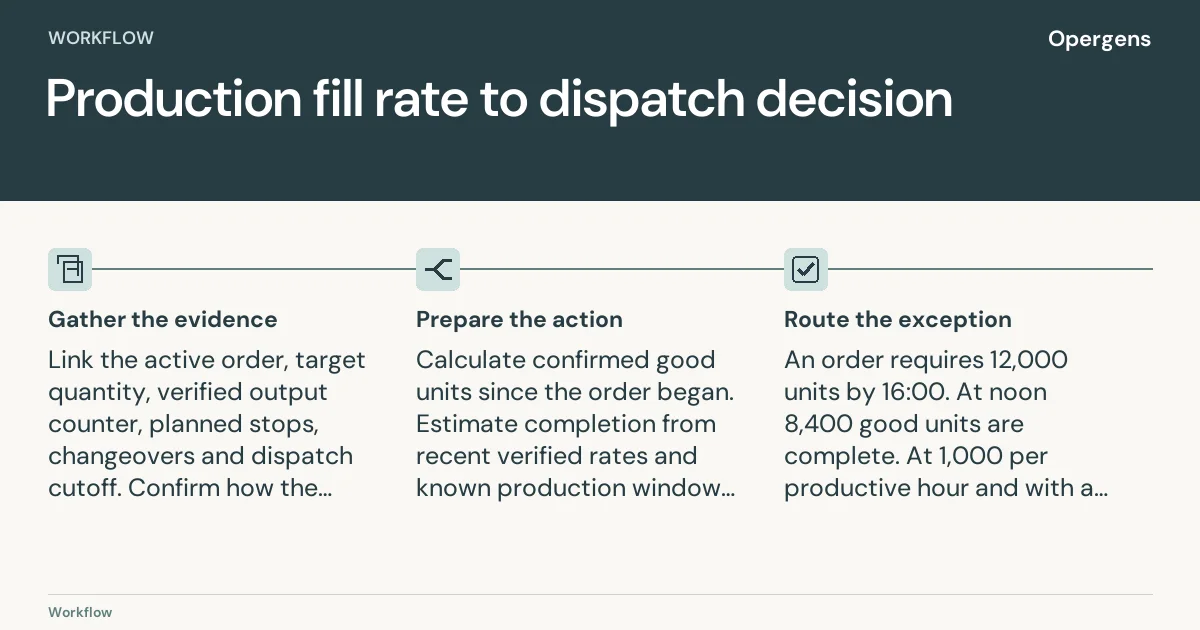
Gather the evidence
Link the active order, target quantity, verified output counter, planned stops, changeovers and dispatch cutoff. Confirm how the counter behaves at a reset and whether rejected units are included. A single instantaneous rate can give a misleading completion estimate.
Prepare the action
Calculate confirmed good units since the order began. Estimate completion from recent verified rates and known production windows. Compare the expected finish with the dispatch deadline. The supervisor investigates an alert and confirms any schedule adjustment with the dispatch owner.
Route the exception
An order requires 12,000 units by 16:00. At noon 8,400 good units are complete. At 1,000 per productive hour and with a scheduled 30-minute stop, the projected finish is 16:06. The supervisor checks the rate and actual stopping plan before revising dispatch.
Compare a complete record with an exception
Source and permissions
Link the active order, target quantity, verified output counter, planned stops, changeovers and dispatch cutoff. Confirm how the counter behaves at a reset and whether rejected units are included. A single instantaneous rate can give a misleading completion estimate.
Exception to rehearse
An order requires 12,000 units by 16:00. At noon 8,400 good units are complete. At 1,000 per productive hour and with a scheduled 30-minute stop, the projected finish is 16:06. The supervisor checks the rate and actual stopping plan before revising dispatch.
Test the workflow on real operating conditions
Replay a counter reset, delayed shift entry, unplanned pause and a change in rejected-unit rate. Evaluate whether alerts arrive early enough for the supervisor to act and whether observed completion is within the uncertainty band documented for that production line.
A fixed rate alarm is straightforward when the line runs a stable product through predictable shifts. An order-aware forecast accounts for remaining quantity, stops and changeovers but depends on reliable timestamps and good-unit counters.
Agree who takes ownership
What Opergens delivers
An order-level view of actual output, forecast completion and uncertainty, with alerts linked to the responsible supervisor and the evidence behind each movement.
What the operator verifies
A supervisor can replay a past order, explain the effect of a stop or rate loss, and decide whether an alert arrives early enough to change dispatch or staffing.
- Gather the evidence
- Link the active order, target quantity, verified output counter, planned stops, changeovers and dispatch cutoff. Confirm how the counter behaves at a reset and whether rejected units are included. A single instantaneous rate can give a misleading completion estimate.
- Prepare the action
- Calculate confirmed good units since the order began. Estimate completion from recent verified rates and known production windows. Compare the expected finish with the dispatch deadline. The supervisor investigates an alert and confirms any schedule adjustment with the dispatch owner.
- Route the exception
- An order requires 12,000 units by 16:00. At noon 8,400 good units are complete. At 1,000 per productive hour and with a scheduled 30-minute stop, the projected finish is 16:06. The supervisor checks the rate and actual stopping plan before revising dispatch.