
Service recovery log
- Release: r-18
- Symptom: empty output from a connector
- Check: known reference record unavailable
- Immediate action: pause publication and retain queued jobs
- Recovery evidence: reference record restored and sampled jobs reconciled
Inspect the review notes
Run the recovery check with the person who will actually receive the alert. Record the time needed to identify affected work, recover dependencies and clear the backlog. If the operator needs a developer to interpret each step, revise the runbook before transferring support.
How the work moves
Follow the operating sequence
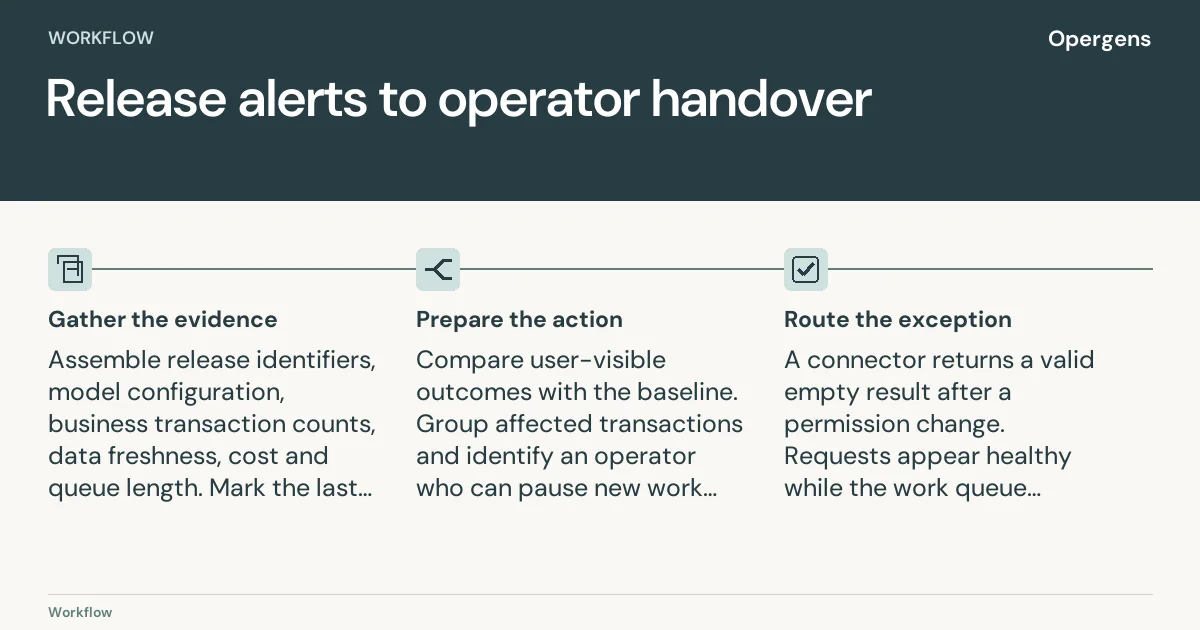
Gather the evidence
Assemble release identifiers, model configuration, business transaction counts, data freshness, cost and queue length. Mark the last healthy version. A successful API status alone gives little evidence that complete, timely results reached the people doing the work.
Prepare the action
Compare user-visible outcomes with the baseline. Group affected transactions and identify an operator who can pause new work without losing pending items. Preserve an incident timeline and the recovery decision. Return a small batch to service first and review it before restoring the full flow.
Route the exception
A connector returns a valid empty result after a permission change. Requests appear healthy while the work queue empties unexpectedly. The runbook checks data coverage against a known control record and asks the operator to pause outward-facing summaries.
Compare a complete record with an exception
Source and permissions
Assemble release identifiers, model configuration, business transaction counts, data freshness, cost and queue length. Mark the last healthy version. A successful API status alone gives little evidence that complete, timely results reached the people doing the work.
Exception to rehearse
A connector returns a valid empty result after a permission change. Requests appear healthy while the work queue empties unexpectedly. The runbook checks data coverage against a known control record and asks the operator to pause outward-facing summaries.
Test the workflow on real operating conditions
Simulate a stale feed, a cost surge and a restored dependency. Confirm the duty operator can identify incomplete jobs, determine whether retries are safe and communicate impact to the process owner. Review the incident after normal service returns.
Agree on the shared line of responsibility before the first incident. A provider can operate the application while the client controls identities and upstream records. Assign an escalation owner for that boundary and give each party the access needed to verify recovery.
Agree who takes ownership
What Opergens delivers
An operating agreement, a support and access matrix, alert thresholds, a recovery rehearsal and a handover option with exportable configuration.
What the operator verifies
During a tabletop incident the duty owner can pause affected work, notify the business, establish the recovery point and reconcile pending transactions.
- Gather the evidence
- Assemble release identifiers, model configuration, business transaction counts, data freshness, cost and queue length. Mark the last healthy version. A successful API status alone gives little evidence that complete, timely results reached the people doing the work.
- Prepare the action
- Compare user-visible outcomes with the baseline. Group affected transactions and identify an operator who can pause new work without losing pending items. Preserve an incident timeline and the recovery decision. Return a small batch to service first and review it before restoring the full flow.
- Route the exception
- A connector returns a valid empty result after a permission change. Requests appear healthy while the work queue empties unexpectedly. The runbook checks data coverage against a known control record and asks the operator to pause outward-facing summaries.