
Service handover summary
- Request one: check the return window
- Request two: review a duplicate charge
- Public policy: return guidance retrieved
- Account identity: check required for billing
- Receiving owner: billing support
- Payment change: none
Inspect the review notes
Audit a sample from the receiving agent’s point of view. Ask what the customer would need to explain again, which promises were made and whether the handover included information the receiving queue is allowed to see. Evaluate at the end of the full service journey.
How the work moves
Follow the operating sequence
Gather the evidence
Start from the approved service knowledge, session context, language preference and the actions available to the signed-in user. Differentiate public information from account-specific information. Preserve the service channel's normal identity check before displaying private records.
Prepare the action
Offer a response tied to the current policy and ask only for missing information. Track unresolved requests as the customer changes topic. At handover, present the customer's question, the steps already tried, source references and any promised follow-up for the agent to verify.
Route the exception
A caller asks about a return and then mentions a duplicate charge. The first issue can use published guidance. The billing issue needs an account check and a finance queue. The handover records both items and avoids asking the caller to repeat the original explanation.
Compare a complete record with an exception
Source and permissions
Start from the approved service knowledge, session context, language preference and the actions available to the signed-in user. Differentiate public information from account-specific information. Preserve the service channel's normal identity check before displaying private records.
Exception to rehearse
A caller asks about a return and then mentions a duplicate charge. The first issue can use published guidance. The billing issue needs an account check and a finance queue. The handover records both items and avoids asking the caller to repeat the original explanation.
Test the workflow on real operating conditions
Test abrupt topic changes, unsupported languages, incorrect assumptions and requests for a person. Score successful resolution alongside transfer quality and repeat contacts. Inspect whether the receiving agent has the authority and evidence to honor any commitment in the summary.
Measure what happens beyond the chat window. A quick answer that produces a second call is expensive for the buyer. Route uncertain or private questions with a summary that identifies completed identity checks, unresolved actions and the policy version consulted.
Agree who takes ownership
What Opergens delivers
A conversation design, approved knowledge sources, a reviewed handover summary and a test set covering ambiguous requests and account-specific actions.
What the operator verifies
A service agent can take over with the context needed to resolve the case. The customer can ask for a person and review the actions proposed on their behalf.
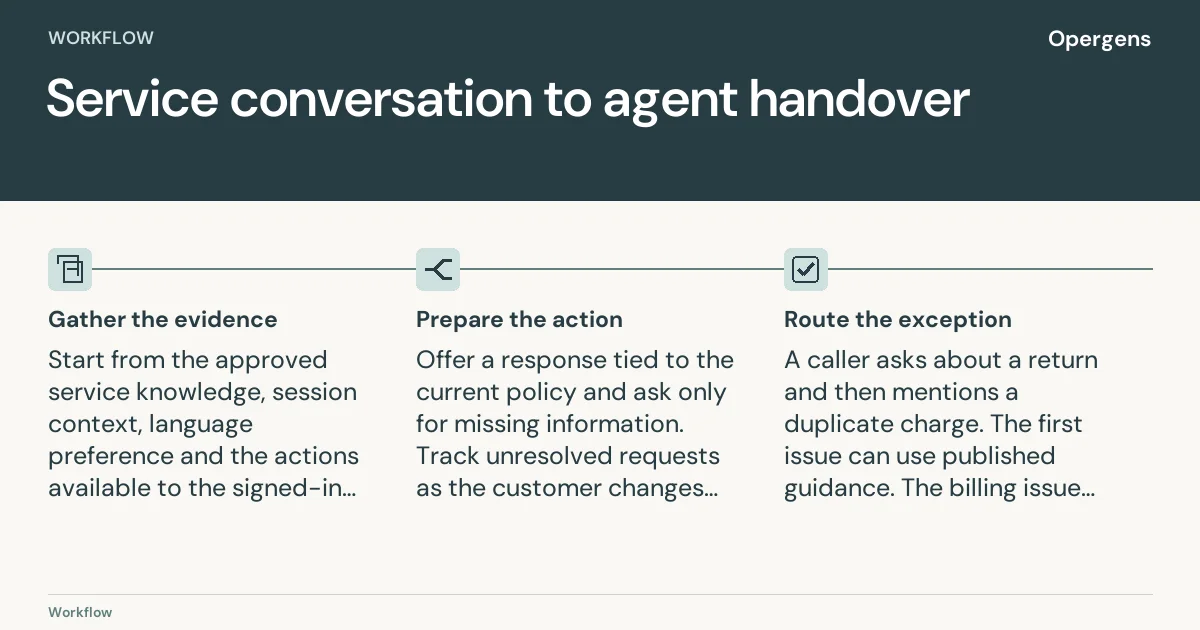
- Gather the evidence
- Start from the approved service knowledge, session context, language preference and the actions available to the signed-in user. Differentiate public information from account-specific information. Preserve the service channel's normal identity check before displaying private records.
- Prepare the action
- Offer a response tied to the current policy and ask only for missing information. Track unresolved requests as the customer changes topic. At handover, present the customer's question, the steps already tried, source references and any promised follow-up for the agent to verify.
- Route the exception
- A caller asks about a return and then mentions a duplicate charge. The first issue can use published guidance. The billing issue needs an account check and a finance queue. The handover records both items and avoids asking the caller to repeat the original explanation.