
Dispatcher exception ticket
- Shipment: S-24
- Confirmed arrival: 15:20 local
- Late departure event received: 15:30 local
- Action: retain delivered status
- Evidence: signed delivery reference
- Next shift: investigate only if the consignee disputes receipt
Inspect the review notes
Review how the process behaves at shift change when two people may hold the same open case. Claiming a case, changing its priority and communicating with the carrier should leave distinct records. This lets the next person see which action has already happened.
How the work moves
Follow the operating sequence
Gather the evidence
Read tracking events, appointment windows, shipment identifiers, carrier updates and the time zones at each stop. Keep event time separate from the time a message arrived. A delayed webhook can otherwise make a completed delivery look as though it is still in transit.
Prepare the action
Reconstruct the latest defensible state of each shipment. Group related exceptions, show the last verified location and list possible contacts. A dispatcher checks carrier information before releasing revised instructions. The incoming shift sees the evidence and the time remaining to act.
Route the exception
A carrier sends an older departure event ten minutes after a delivery confirmation. The draft handover retains the confirmed delivery, records the late message separately and avoids opening a new delay incident for the same shipment.
Compare a complete record with an exception
Source and permissions
Read tracking events, appointment windows, shipment identifiers, carrier updates and the time zones at each stop. Keep event time separate from the time a message arrived. A delayed webhook can otherwise make a completed delivery look as though it is still in transit.
Exception to rehearse
A carrier sends an older departure event ten minutes after a delivery confirmation. The draft handover retains the confirmed delivery, records the late message separately and avoids opening a new delay incident for the same shipment.
Test the workflow on real operating conditions
Replay duplicated and out-of-order messages, a missing carrier feed and a deadline across time zones. Measure actionable exceptions detected before cutoff and time spent clearing false alarms. Ask the next shift to explain one flagged shipment from the pack alone.
Design backwards from a partially completed run. List the durable event that records progress and the check that prevents a repeated side effect. Leave a place for the operating team to resume from the last verified state when a dependency recovers.
Agree who takes ownership
What Opergens delivers
A workflow that prepares, routes or reconciles work with visible queues and approval points.
What the operator verifies
A process owner can pause the workflow, inspect exceptions and recover from a partial run.
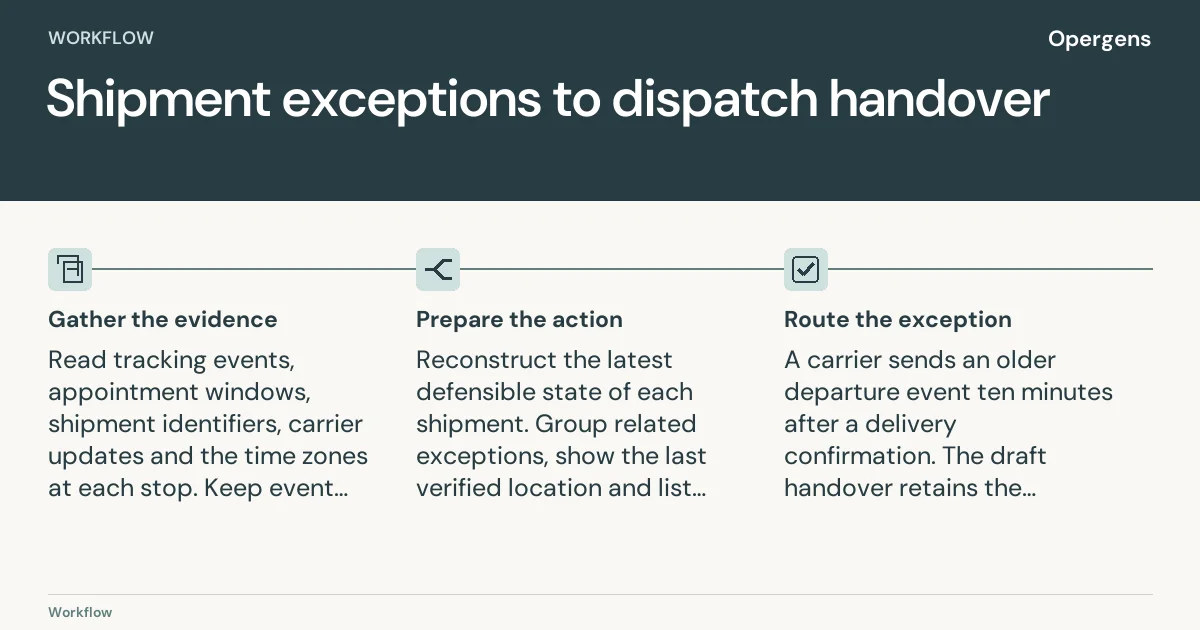
- Gather the evidence
- Read tracking events, appointment windows, shipment identifiers, carrier updates and the time zones at each stop. Keep event time separate from the time a message arrived. A delayed webhook can otherwise make a completed delivery look as though it is still in transit.
- Prepare the action
- Reconstruct the latest defensible state of each shipment. Group related exceptions, show the last verified location and list possible contacts. A dispatcher checks carrier information before releasing revised instructions. The incoming shift sees the evidence and the time remaining to act.
- Route the exception
- A carrier sends an older departure event ten minutes after a delivery confirmation. The draft handover retains the confirmed delivery, records the late message separately and avoids opening a new delay incident for the same shipment.