
Pilot recovery decision
- Prior obstacle: manual rekeying of approved document fields
- Trial: structured export into the case system
- Evidence required: fewer rekeyed fields and acceptable correction time
- Decision owner: case operations lead
- Next investment: pending comparison
Inspect the review notes
Recover the pilot only when a proposed fix can settle an important open question. If the main issue is the absence of an operational owner, a more polished model will provide little new evidence. Record the stopping condition alongside the next test before allocating more effort.
How the work moves
Follow the operating sequence
Gather the evidence
Reconstruct the original user task, acceptance evidence and operating owner. Review representative misses with the people doing the work. Separate an unreliable data source from model behavior, excessive review cost and a workflow that never reached its intended user.
Prepare the action
Choose the smallest test that distinguishes the competing explanations. Keep existing development artifacts intact and agree a time and spending boundary for the recovery attempt. Provide a decision memo showing what changed, what remains uncertain and who is prepared to operate any further release.
Route the exception
A document assistant passes offline tests, yet reviewers still retype every field. Observation reveals that their case system accepts only structured rows. A short export trial can test whether the missing handoff explains the stalled use before changing the model.
Compare a complete record with an exception
Source and permissions
Reconstruct the original user task, acceptance evidence and operating owner. Review representative misses with the people doing the work. Separate an unreliable data source from model behavior, excessive review cost and a workflow that never reached its intended user.
Exception to rehearse
A document assistant passes offline tests, yet reviewers still retype every field. Observation reveals that their case system accepts only structured rows. A short export trial can test whether the missing handoff explains the stalled use before changing the model.
Test the workflow on real operating conditions
Run the old and repaired routes on the same work. Measure complete handling time, correction effort and exceptions reaching the downstream system. An owner must be able to state which evidence supports continuing, redesigning or stopping the investment.
A stalled pilot can fail because the wrong user received it, a connector never reached production, the evaluation ignored difficult work or review consumed all the savings. Test the most consequential explanation first. Keep a clear exit decision available to the sponsor.
Agree who takes ownership
What Opergens delivers
A failure analysis, one bounded recovery experiment and a decision memo that covers integration changes, maintenance cost and who will own the next release.
What the operator verifies
The sponsor can compare the original and revised route on representative work and justify continuing, changing direction or retiring the pilot.
- Gather the evidence
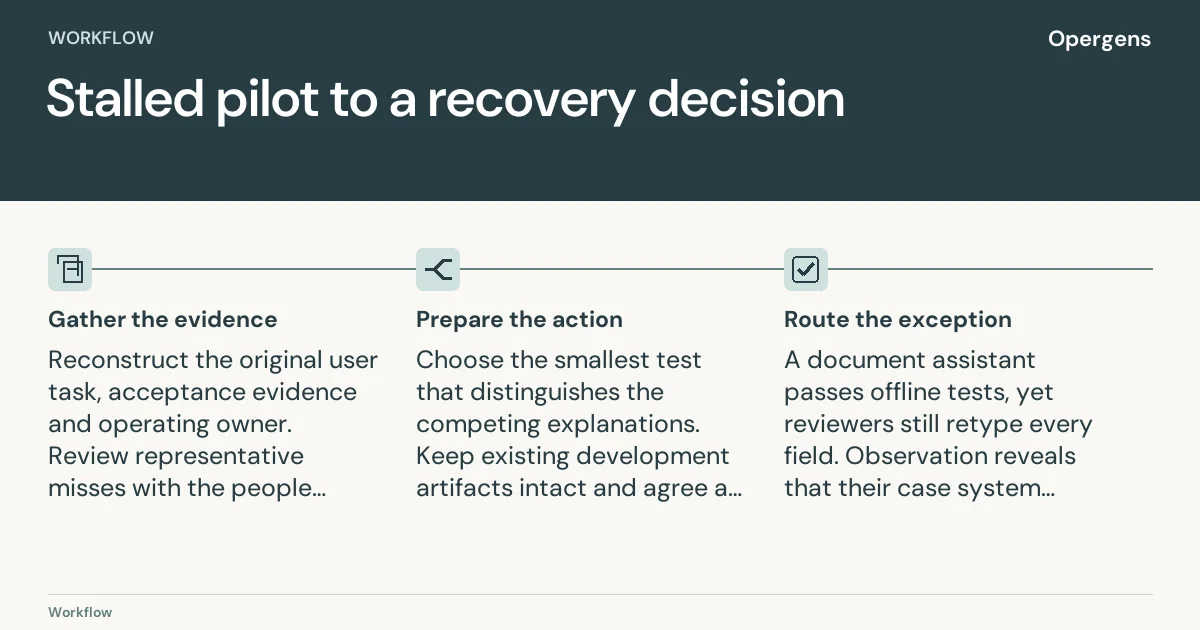
- Reconstruct the original user task, acceptance evidence and operating owner. Review representative misses with the people doing the work. Separate an unreliable data source from model behavior, excessive review cost and a workflow that never reached its intended user.
- Prepare the action
- Choose the smallest test that distinguishes the competing explanations. Keep existing development artifacts intact and agree a time and spending boundary for the recovery attempt. Provide a decision memo showing what changed, what remains uncertain and who is prepared to operate any further release.
- Route the exception
- A document assistant passes offline tests, yet reviewers still retype every field. Observation reveals that their case system accepts only structured rows. A short export trial can test whether the missing handoff explains the stalled use before changing the model.