
Name the new purchase
A pilot shows that a workflow can produce a useful result on a defined set of cases. Production introduces identity, service ownership, support hours, changing inputs and the cost of recovery. A sponsor should be able to see the price and responsibility attached to each of those commitments.
- Name the new purchase
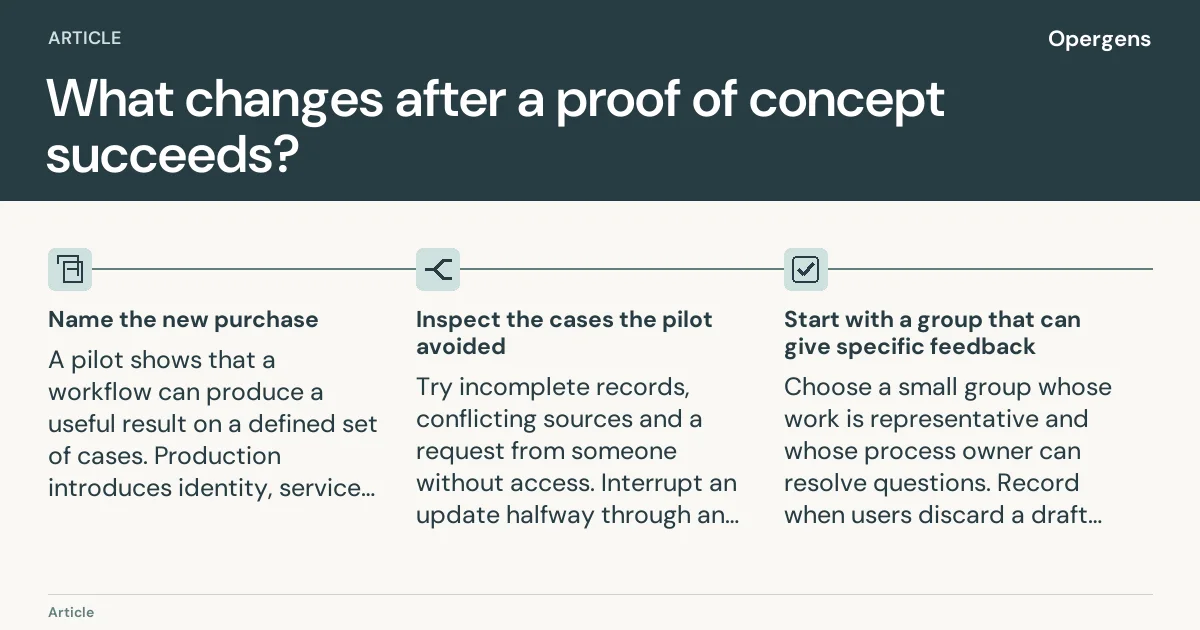
- A pilot shows that a workflow can produce a useful result on a defined set of cases. Production introduces identity, service ownership, support hours, changing inputs and the cost of recovery. A sponsor should be able to see the price and responsibility attached to each of those commitments.
- Inspect the cases the pilot avoided
- Try incomplete records, conflicting sources and a request from someone without access. Interrupt an update halfway through and replay it. Check whether the work is visible in an exception queue and whether the reviewer can tell which action already succeeded.
- Start with a group that can give specific feedback
- Choose a small group whose work is representative and whose process owner can resolve questions. Record when users discard a draft, bypass the tool or ask a colleague to check the output. These events can reveal more than the number of people who opened the application.
Inspect the cases the pilot avoided
Try incomplete records, conflicting sources and a request from someone without access. Interrupt an update halfway through and replay it. Check whether the work is visible in an exception queue and whether the reviewer can tell which action already succeeded.
Start with a group that can give specific feedback
Choose a small group whose work is representative and whose process owner can resolve questions. Record when users discard a draft, bypass the tool or ask a colleague to check the output. These events can reveal more than the number of people who opened the application.
Give someone authority to stop
Document the conditions for pausing the release, who can approve a rollback and how the business continues manually. Those decisions make it possible to expand confidently as technical and operational evidence improves.
The second branch is a new test
A pilot may know every customer by a single account code. The next branch might reuse those codes in a different ledger. Before opening access, run a case where the same code exists in both branches. Ask the reviewer to identify the correct legal entity from the proposed result. The test exposes whether the connector and interface preserve that boundary.
Separate the decisions on the calendar
A sponsor can approve a limited release at the first desk and defer the second branch until its access rules and local owner are ready. Record those as separate decisions in the plan. A successful demonstration should never leave operations guessing which sites were authorized.