
What would it take to put a successful AI pilot into production?
Start with the decision preventing release. Find who can accept the risk, what evidence they need and who will answer when the service fails. Run the smallest release that can supply that evidence.
A second branch uses the same customer numbers
At the pilot desk, account codes identify customers uniquely. At the next branch, two ledgers reuse the same codes. A convincing demo could now return another account’s record.
Follow a pilot recovery decisionWhat you take away
A release brief with explicit acceptance checks, funding assumptions, recovery instructions and named owners. The sponsor can approve one branch, defer another or stop with the evidence recorded.
Pilot design and recoveryWhat to measure
Check correctness by branch and user role. Include manual recovery time and the effort of running both workflows during rollout. Revisit the investment decision if another site needs substantially more support.
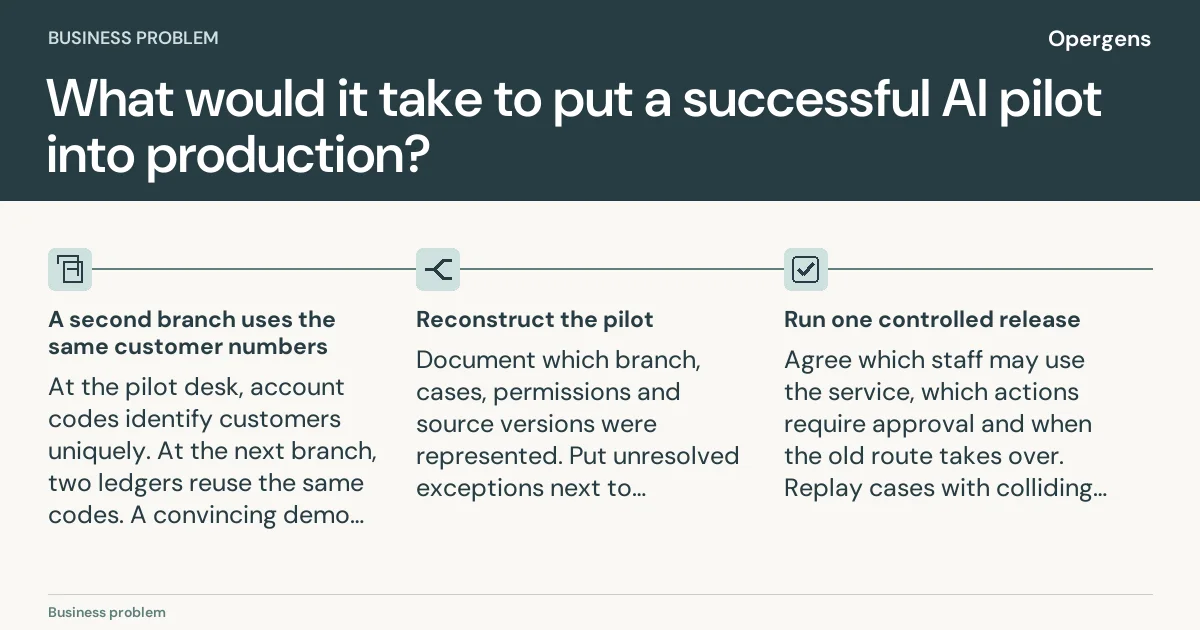
- A second branch uses the same customer numbers
- At the pilot desk, account codes identify customers uniquely. At the next branch, two ledgers reuse the same codes. A convincing demo could now return another account’s record.
- Reconstruct the pilot
- Document which branch, cases, permissions and source versions were represented. Put unresolved exceptions next to successful outputs so the release owner can see the boundary.
- Run one controlled release
- Agree which staff may use the service, which actions require approval and when the old route takes over. Replay cases with colliding account codes before enabling the next group.