
Capacity scenario record
- Baseline: one inspection station and one packing slot
- Scenario: add a second packing slot
- Observed effect in the example: inspection queue grows
- Open decision: trial a changed inspection window before buying packing capacity
Inspect the review notes
Bring the model back to the people who work the shift. Ask which simulated event they would immediately recognize as impossible. A planner may approve using a rough model to compare staffing options while requiring more precise calibration before evaluating equipment investment.
How the work moves
Follow the operating sequence
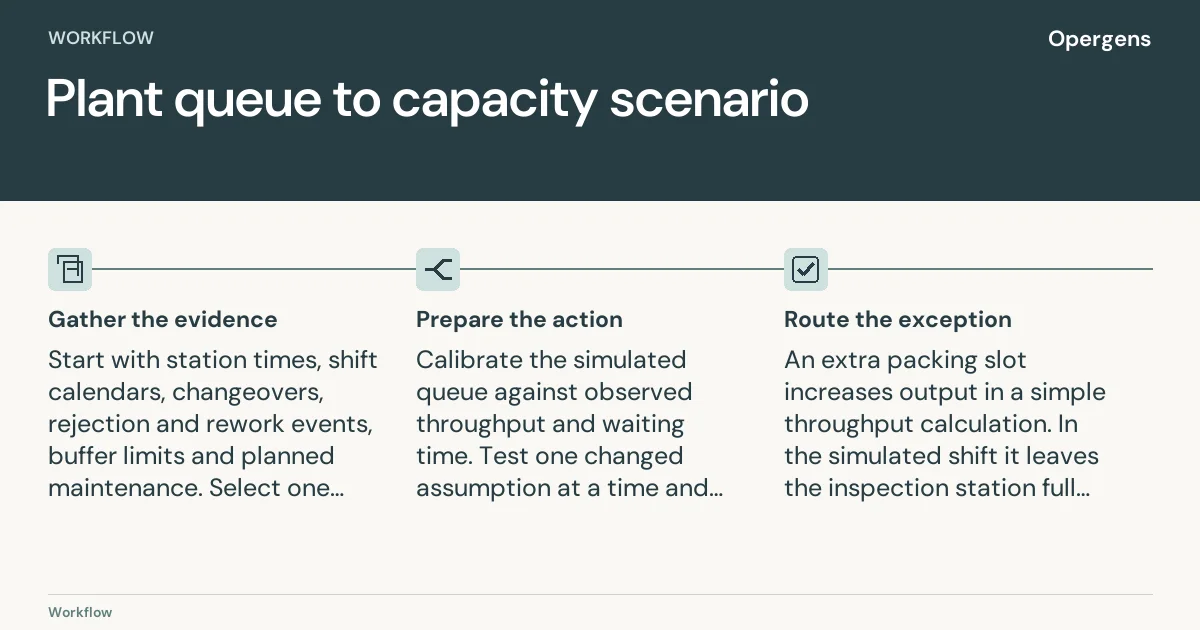
Gather the evidence
Start with station times, shift calendars, changeovers, rejection and rework events, buffer limits and planned maintenance. Select one bottleneck and a historical shift to replay. Real operators can identify impossible transitions that look perfectly legal in a planning spreadsheet.
Prepare the action
Calibrate the simulated queue against observed throughput and waiting time. Test one changed assumption at a time and retain the original as a reference. Include a range for repair or changeover duration. Operations signs off on a trial window and keeps the existing control system in charge.
Route the exception
An extra packing slot increases output in a simple throughput calculation. In the simulated shift it leaves the inspection station full and increases work in progress. The comparison shows both the packing improvement and the downstream queue for the supervisor to evaluate.
Compare a complete record with an exception
Source and permissions
Start with station times, shift calendars, changeovers, rejection and rework events, buffer limits and planned maintenance. Select one bottleneck and a historical shift to replay. Real operators can identify impossible transitions that look perfectly legal in a planning spreadsheet.
Exception to rehearse
An extra packing slot increases output in a simple throughput calculation. In the simulated shift it leaves the inspection station full and increases work in progress. The comparison shows both the packing improvement and the downstream queue for the supervisor to evaluate.
Test the workflow on real operating conditions
Reserve shifts that were not used for calibration. Check whether the model reproduces the order and duration of disruptions closely enough for the decision. Report uncertainty with every scenario and record which observations would justify recalibration.
Use the simplest representation that captures the constraint being tested. Detailed geometry adds little to a staffing decision driven by variable queue lengths. An engineer should be able to identify which clock, resource or transition controls each scenario result.
Agree who takes ownership
What Opergens delivers
A calibrated baseline, a scenario comparison with uncertainty, and a record of the operating conditions in which the model is credible.
What the operator verifies
A held-out shift reproduces the agreed reference measures closely enough for planning. Supervisors understand which proposed changes require a supervised physical trial.
- Gather the evidence
- Start with station times, shift calendars, changeovers, rejection and rework events, buffer limits and planned maintenance. Select one bottleneck and a historical shift to replay. Real operators can identify impossible transitions that look perfectly legal in a planning spreadsheet.
- Prepare the action
- Calibrate the simulated queue against observed throughput and waiting time. Test one changed assumption at a time and retain the original as a reference. Include a range for repair or changeover duration. Operations signs off on a trial window and keeps the existing control system in charge.
- Route the exception
- An extra packing slot increases output in a simple throughput calculation. In the simulated shift it leaves the inspection station full and increases work in progress. The comparison shows both the packing improvement and the downstream queue for the supervisor to evaluate.