
The assumption register
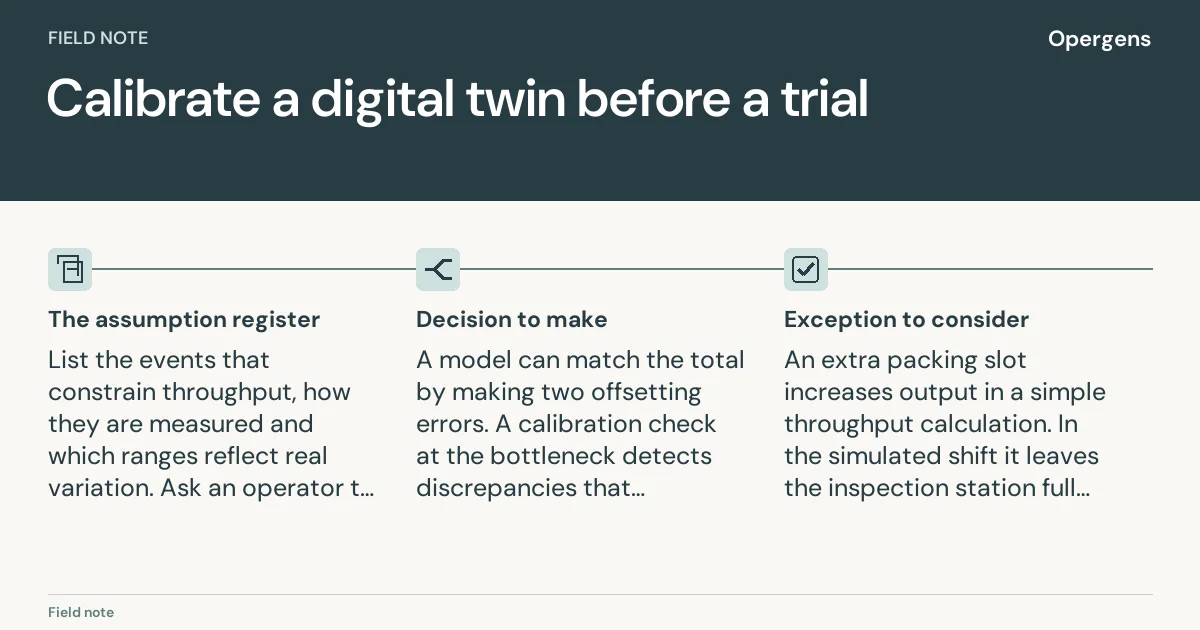
List the events that constrain throughput, how they are measured and which ranges reflect real variation. Ask an operator to annotate a held-out shift. Compare queue lengths and waiting time as well as total output.
Decision to make
A model can match the total by making two offsetting errors. A calibration check at the bottleneck detects discrepancies that disappear at the monthly production level.
Exception to consider
An extra packing slot increases output in a simple throughput calculation. In the simulated shift it leaves the inspection station full and increases work in progress. The comparison shows both the packing improvement and the downstream queue for the supervisor to evaluate.
Use this guide
Inspect a completed decision record
Capacity scenario record
- Baseline: one inspection station and one packing slot
- Scenario: add a second packing slot
- Observed effect in the example: inspection queue grows
- Open decision: trial a changed inspection window before buying packing capacity
Inspect the review notes
Bring the model back to the people who work the shift. Ask which simulated event they would immediately recognize as impossible. A planner may approve using a rough model to compare staffing options while requiring more precise calibration before evaluating equipment investment.
Set up the trial
Collect comparable examples
Start with station times, shift calendars, changeovers, rejection and rework events, buffer limits and planned maintenance. Select one bottleneck and a historical shift to replay. Real operators can identify impossible transitions that look perfectly legal in a planning spreadsheet.
Observe the handoff
Calibrate the simulated queue against observed throughput and waiting time. Test one changed assumption at a time and retain the original as a reference. Include a range for repair or changeover duration. Operations signs off on a trial window and keeps the existing control system in charge.
Review the evidence
Reserve shifts that were not used for calibration. Check whether the model reproduces the order and duration of disruptions closely enough for the decision. Report uncertainty with every scenario and record which observations would justify recalibration.
Adapt the scope to your organization
Start with one team
Represent one shift and one bottleneck. Ask the supervisor to challenge impossible transitions before testing an investment.
Extend across teams
Replay multiple lines and shifts, calibrate against held-out events and publish operating bounds for reuse after layout or equipment changes.
- The assumption register
- List the events that constrain throughput, how they are measured and which ranges reflect real variation. Ask an operator to annotate a held-out shift. Compare queue lengths and waiting time as well as total output.
- Decision to make
- A model can match the total by making two offsetting errors. A calibration check at the bottleneck detects discrepancies that disappear at the monthly production level.
- Exception to consider
- An extra packing slot increases output in a simple throughput calculation. In the simulated shift it leaves the inspection station full and increases work in progress. The comparison shows both the packing improvement and the downstream queue for the supervisor to evaluate.